

Recent cyber attacks on major automotive manufacturers in the UK have exposed a hard truth: modern industrial operations are far more fragile than they appear.
In one widely reported incident, ransomware halted production across multiple plants, disrupting supply chains and stopping the manufacture of over a thousand vehicles per day. The headlines focused on financial loss. The deeper lesson was more unsettling:
Scale, automation, and digital sophistication do not automatically create cyber resilience.
As ransomware targeting manufacturing surged in early 2025, one pattern became clear — the more connected factories become, the larger the attack surface grows. IT and Operational Technology (OT) convergence has unlocked efficiency, but it has also erased traditional boundaries.
Industrial cyber security is no longer just about protecting data.
It is about protecting the machines that keep production alive.
When Uptime Becomes Vulnerability
For decades, industrial security strategy focused on availability — keep the line running at all costs.
Today, uptime without security is a liability.
In highly automated environments, once attackers gain a foothold, disruption happens at machine speed. What once took hours now happens in seconds.
The shift is profound:
IT incidents disrupt information
OT incidents disrupt physics
And physics cannot be rolled back with a restore point.
Case Study 1: Automotive Production Shutdown (UK / Europe)
What Happened
Ransomware entered via a trusted third-party connection
OT systems were taken offline as a precaution
Assembly lines stopped across multiple sites
The Deeper Issue
Network segmentation existed — but internal OT devices lacked embedded security controls. Once attackers accessed the environment, they were able to move laterally across interconnected systems.
Strategic Insight
Industrial drives, controllers, and PLCs often operate without secure boot mechanisms, firmware validation, or strong authentication. These devices unintentionally become force multipliers for cyber attackers.
When device-level security is weak, segmentation alone is insufficient.
Case Study 2: Food & Beverage Manufacturer (North America)
What Happened
Remote access credentials reused across multiple facilities
PLCs and variable frequency drives were manipulated
Process parameters were altered
Product spoilage occurred before detection
The Deeper Issue
The attack did not immediately steal data — it disrupted process integrity. The damage was operational and safety-related before it was informational.
Strategic Insight
Availability and safety risks often emerge before financial impact becomes visible. Role-based access control and device-level authentication could have drastically reduced lateral movement.
In OT, integrity failures are often more damaging than data breaches.
Case Study 3: Water Utility Incident (Global Pattern)
What Happened
Internet-exposed control components
Weak or default authentication
Manual intervention prevented physical damage
The Deeper Issue
This was not an advanced nation-state attack. It was exploitation of insecure defaults.
Strategic Insight
Industrial incidents frequently stem from basic misconfigurations rather than sophisticated zero-day exploits.
Secure-by-design devices reduce dependence on constant human vigilance.
Why Industrial Drives Are Now High-Risk Cyber Assets
Industrial drives sit at the intersection of digital instruction and physical motion.
They:
Regulate speed and torque
Control pumps, compressors, conveyors
Directly influence production output
Operate continuously
In modern smart factories, drives are increasingly:
Network-connected
Remotely configurable
Integrated with analytics platforms
Exposed through IIoT gateways
This connectivity transforms them from mechanical components into cyber-physical risk nodes.
A compromised drive can:
Halt production
Alter product quality
Cause mechanical stress
Trigger safety hazards
The risk profile has fundamentally changed.
What “Secure-by-Design” Means in OT
Secure-by-design in industrial environments means security is built into the device architecture — not bolted on later.
It includes:
Secure boot to prevent unauthorized firmware
Cryptographically signed updates
Role-based authentication
Encrypted communications
Disabled insecure default services
Hardware root of trust
Secure-by-design reduces reliance on perimeter defenses alone and assumes breaches will happen.
How Connectivity Is Changing Industrial Risk
The industrial risk equation has evolved:
Then: Isolated control networks
Now: Cloud-integrated, analytics-driven, vendor-connected ecosystems
Modern risk drivers include:
Remote maintenance access
Predictive maintenance platforms
Third-party integrators
Data-driven performance optimization
Converged IT/OT management tools
Each integration point introduces trust dependencies.
Resilience now depends on managing those dependencies deliberately.
Regulatory Pressure Is Rising
Governments are responding to industrial cyber incidents with stronger regulatory oversight.
Emerging and strengthening frameworks include:
NIS2 Directive (Europe)
Critical Infrastructure Protection regulations
Mandatory breach notification laws
Sector-specific cyber compliance standards
Regulators increasingly expect:
Asset visibility
Secure configuration management
Incident response readiness
Supplier risk management
Secure procurement practices
Compliance is no longer optional in critical sectors.
Building a Strong Security Footprint in Industrial Systems
Industrial cyber security must move from reactive detection to proactive resilience.
Below are foundational prevention strategies that strengthen OT environments.
1. Enforce Network Segmentation — With Device-Level Hardening
Segmentation remains essential, but it must be paired with:
Secure configuration baselines
Disabled unused services
Strict access control lists
Industrial DMZ architectures
Defense-in-depth, not perimeter-only.
2. Implement Zero-Trust Principles in OT
Adopt:
Identity-based access
Least privilege
Time-bound remote sessions
Continuous authentication validation
Trust must be verified continuously, not assumed.
3. Secure Remote Access Rigorously
MFA for all remote access
No shared credentials
Encrypted VPN with logging
Session recording for vendor access
Most major OT breaches begin with remote access compromise.
4. Harden Industrial Devices
Enable secure boot
Validate firmware signatures
Remove default credentials
Disable unused ports and protocols
Regularly verify configuration integrity
Machines must be treated as critical cyber assets.
5. Continuous Monitoring of OT Environments
Deploy OT-aware monitoring tools capable of:
Detecting abnormal command sequences
Identifying unexpected configuration changes
Monitoring process anomalies
Visibility must extend beyond IT logs into process telemetry.
6. Strengthen Supply Chain Security
Assess third-party security posture
Review remote maintenance contracts
Validate patch management practices
Include security requirements in procurement specifications
Procurement decisions shape long-term resilience.
Questions Procurement Teams Should Ask Before Buying Drives
Does the device support secure boot and signed firmware?
Is role-based authentication enforced?
Are communications encrypted by default?
Can security logs be exported to a SIEM?
Are insecure protocols disabled by default?
Is there a documented vulnerability management program?
Security must become a selection criterion — not an afterthought.
From Performance to Survival
Industrial cyber security is no longer separate from performance — it underpins it.
Every gain in automation, connectivity and efficiency depends on trust in the systems that control physical processes.
As ransomware and supply-chain attacks continue to rise, securing industrial drives is no longer a niche technical detail. It is a strategic decision that determines whether factories can operate safely, compliantly and continuously.
In the next generation of manufacturing, resilience will belong to those who make smarter choices at the machine level — before incidents force the lesson.
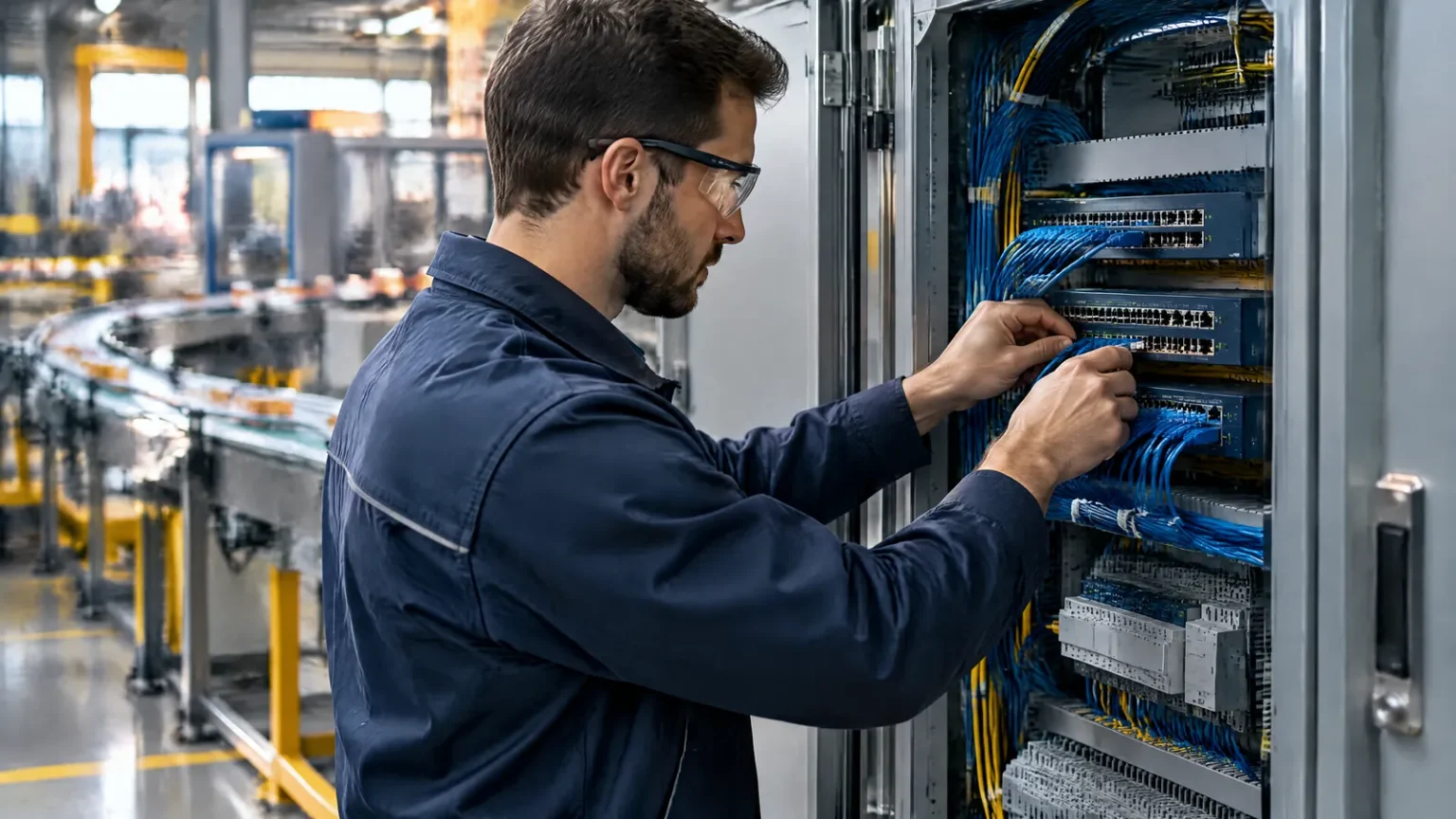
Industrial cyber security is no longer separate from performance — it underpins it. Every gain in automation, connectivity and efficiency depends on trust in the systems that control physical processes.
As ransomware and supply-chain attacks continue to rise, securing industrial drives is no longer a niche concern or a technical detail. It is a strategic decision that determines whether factories can operate safely, compliantly and continuously.
In the next generation of manufacturing, resilience will belong to those who make smarter choices at the machine level — before incidents force the lesson.
Read more AI and the future of Cyber Security
https://www.secsolutionshub.com/ai-and-the-future-of-cybersecurity-opportunities-risks-and-the-way-forward/

