Enterprise risk management (ERM) gives your board and executives one view of every material risk to the organisation’s objectives, and a consistent way to decide which risks to accept, reduce, transfer or avoid. Security Solution Consultants (SSC) provides enterprise risk management services to Australian and New Zealand organisations, designing and uplifting ERM frameworks from mid-sized businesses to APRA-regulated institutions and critical infrastructure operators, so that risk management informs strategy instead of sitting in a register nobody reads.

Our approach aligns with ISO 31000:2018 risk management guidelines and the COSO Enterprise Risk Management framework, and connects to the operational, cyber and compliance standards you already answer to, including ISO/IEC 27001, APRA CPS 220 and CPS 230, and the SOCI Act Critical Infrastructure Risk Management Program (CIRMP).
For a step-by-step explanation of each stage, from risk identification to continuous improvement, read our guide to the enterprise risk management process.

Effective risk management depends on everyone knowing their role. We design responsibilities around the Institute of Internal Auditors’ Three Lines Model:
Getting this right avoids two common failures: a risk team that owns every risk on behalf of the business, and a business that treats risk management as someone else’s paperwork.

A risk appetite statement is only useful if managers can apply it. We write appetite statements by risk category, then translate each into tolerances and KRIs: for example, maximum tolerable outage for a critical service, the number of overdue high-risk audit findings, staff turnover in key roles, or the percentage of critical vulnerabilities fixed within agreed timeframes. When a KRI moves outside tolerance, the escalation path and decision owner are already agreed.
| Obligation | What it means for ERM |
|---|---|
| ISO 31000:2018 | Internationally recognised guidelines for risk management principles, framework and process. Not certifiable, but the common reference point for ERM design. |
| APRA CPS 220 Risk Management | APRA-regulated institutions need a board-approved risk management framework, a risk management strategy, a risk appetite statement and a designated compliance function. |
| APRA CPS 230 Operational Risk Management | Operational risk, critical operations, tolerance levels for disruption and material service provider management, in force since 1 July 2025. |
| SOCI Act CIRMP | Responsible entities for critical infrastructure assets maintain a risk management program and submit a board-approved annual report within 90 days of the end of the Australian financial year. |
| NZ directors’ duties and sector rules | New Zealand boards are expected to oversee material risks; financial institutions also manage conduct risk under the regime overseen by the Financial Markets Authority. |
Read more in our guide to the enterprise risk management framework for Australian organisations and our article on CPS 230 compliance after transition.
Cyber incidents now sit among the most significant risks for most boards, yet cyber is often reported in technical language that directors cannot compare with other risks. We connect your cyber and information security risk assessments to the enterprise register, express them in terms of impact on customers, operations, revenue and obligations, and report them with the same scale as every other risk. Our board cyber risk KRI guide shows the indicators we typically recommend.
For a deeper look at AI-related risk, see ISO 31000 vs ISO 23894 and risk appetite in the age of AI.
A risk framework stays alive when the register, controls, actions and KRIs live in one system. SSC builds GRCLens, a GRC platform that holds your risk register, control library, treatment actions, evidence and dashboards, and links risks to the compliance obligations they affect. Boards see the same numbers as risk owners, and reporting packs take hours instead of weeks. We also work with your existing GRC tool if you have one.
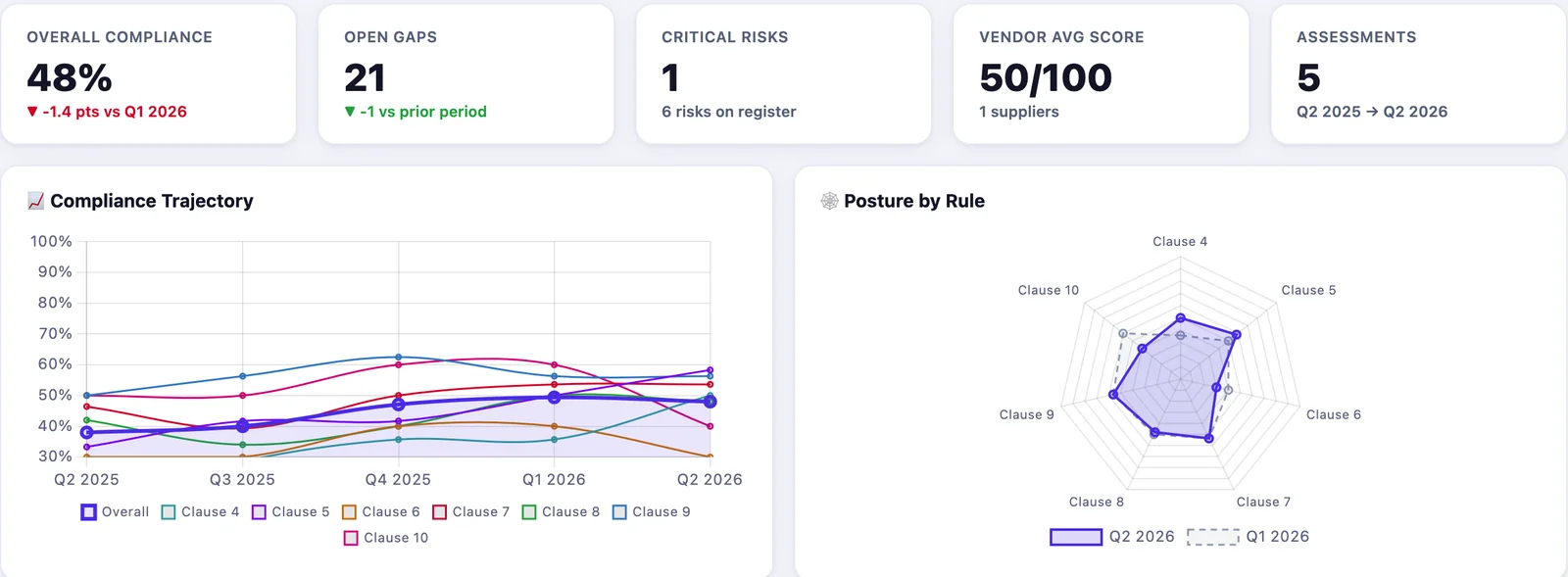
If several of these sound familiar, a short framework review is usually the fastest way to find the few changes that make the biggest difference.
Most risks are best rated with a clear qualitative scale. For a small number of high-impact risks, such as a major cyber incident, loss of a critical supplier or prolonged outage of a core system, a quantitative estimate of likely and worst-case financial impact helps the board compare the cost of treatment with the exposure it removes. We use scenario analysis and, where the data supports it, simple quantitative models to give a range rather than a false single number, and we explain the assumptions in plain language.
Related services: compliance risk management, business continuity management and security certification and accreditation. To discuss your risk framework, contact our team.