

Security Solution Consultants (SSC) delivers the cyber security services Hamilton and Waikato organisations turn to when a dairy customer, a health buyer, a regulator or their own board wants evidence that systems and information are protected. This page is about Hamilton, Waikato, in New Zealand, and the towns around it. We are based in Tarneit, Victoria 3029, work remote-first and come on site for processing plants, OT, data centres, workshops and findings walkthroughs where that adds value. The work covers ISO 22000 and ISO 27001 readiness, Privacy Act 2020 uplift, HISO 10029 evidence, incident response planning and internal audits before external assessors arrive.
The Waikato economy is built on dairy, agritech and the services around them. Regional GDP is about $36.5 billion, exports reached $8.8 billion in 2024, and the region carries 22.6% of New Zealand’s dairy cows. Gallagher, headquartered in Hamilton since 1938, has more than 1,700 staff, and its security business announced up to 100 new roles in April 2026. LIC is based at Newstead, Waikato Innovation Park hosts about 50 agritech and biotech firms, and Waikato Hospital has 600 beds. Each of these groups is asked for different evidence, yet most of it rests on the same handful of controls.
Which rules apply in the Waikato
New Zealand sets its cyber security and privacy rules nationally, so Waikato organisations work to the same law as everyone else. What differs is the mix: food safety, health and water services weigh more heavily here than in most regions. The diagram shows which obligations land on which type of organisation.
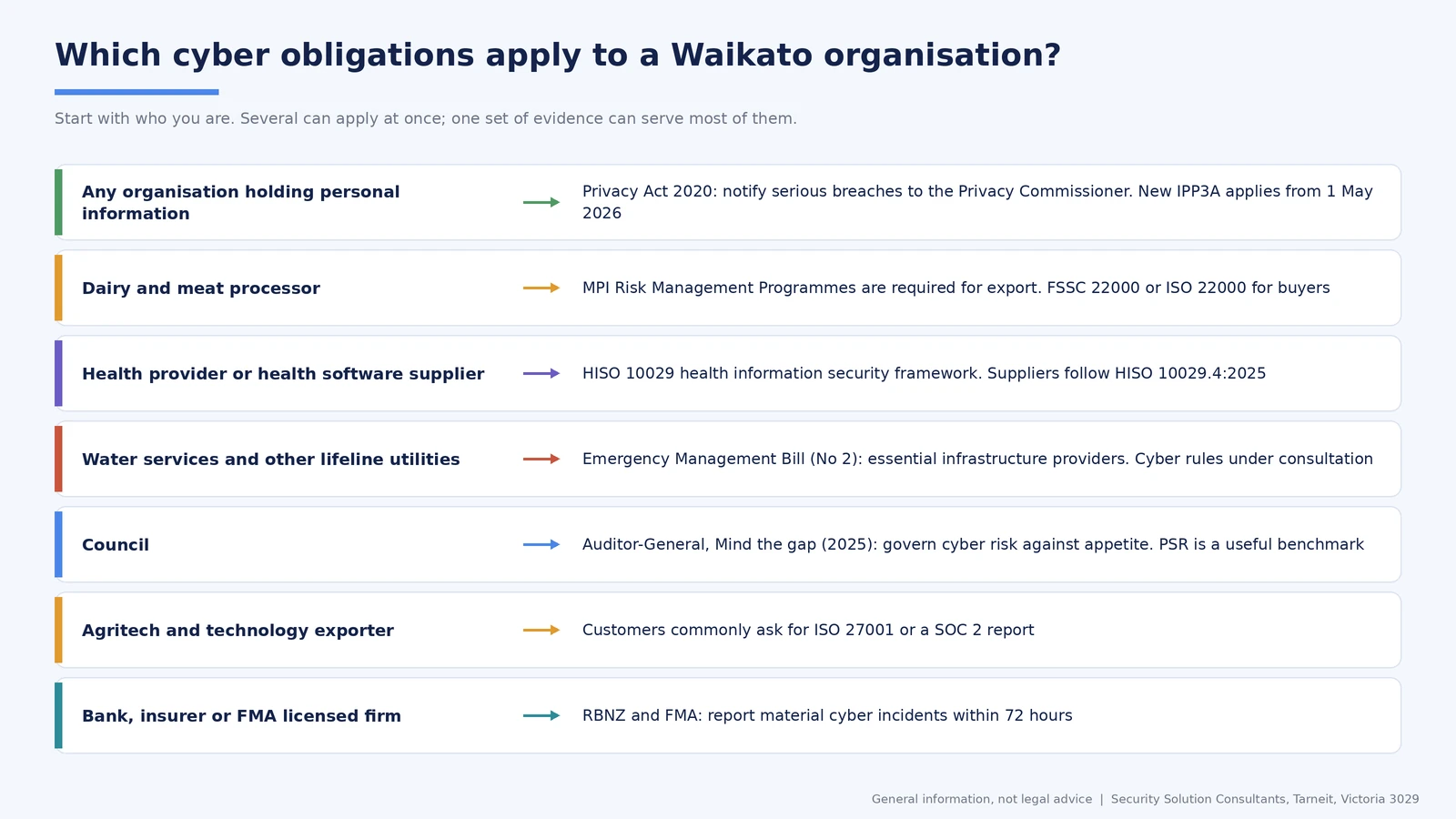
Councils and water organisations. Hamilton City Council, Waikato Regional Council, Waikato District Council and Waipā District Council are not PSR-mandated agencies, but they hold extensive personal information under the Privacy Act 2020. Two new water services organisations began operating on 1 July 2026: IAWAI Flowing Waters, with about 90,700 connections, and Waikato Waters Ltd. As water suppliers they are lifeline utilities, and the Emergency Management Bill (No 2) turns lifeline utilities into essential infrastructure providers.
Health providers. Waikato Hospital, primary care providers, general practices and their technology suppliers work to HISO 10029, with HISO 10029.4:2025 setting expectations for suppliers. Pinnacle Midlands Health Network, which serves about 450,000 patients, had a third-party server accessed on 28 September 2022, a reminder that health data risk extends to the suppliers who host and support systems.
Food processors and exporters. Dairy and meat processors and their export chain must operate MPI Risk Management Programmes. Cyber security is not the focus of an RMP, but the records an RMP depends on, from production data to laboratory results, now live in systems that need protecting.
Suppliers to government. Waikato manufacturers, engineering firms and software companies that sell to public service departments, NZDF or Police meet the Protective Security Requirements through GOV 5 contract clauses and the NZISM v3.9 controls those contracts reference.
Every organisation. The Privacy Act 2020 applies regardless of size, and notifiable breaches go to the Privacy Commissioner, ideally within 72 hours. Sites that use fingerprint or facial recognition for access control or timesheets also need to consider the Biometric Processing Privacy Code 2025, which has applied to new processing since 3 November 2025 and to existing processing since 3 August 2026.
Certifications Hamilton businesses ask us about
Most certification demand in the Waikato comes from customers and export markets rather than from law. These six come up regularly.
- ISO 22000 and FSSC 22000. Waikato dairy processors operate under MPI Risk Management Programmes, and international customers commonly ask for a certified food safety management system as well. The region has history here: Tatua became the first New Zealand company certified to FSSC 22000, in 2011. We align the food safety management system with your RMP so the same verification records serve both, and we cover the food defence and food fraud requirements that FSSC 22000 adds.
- ISO/IEC 27001. Agritech businesses that hold farm, herd or genetic data for their clients find that one certified management system answers most customer questionnaires, and security technology manufacturers and their suppliers face similar requests. Certification is issued by an accredited certification body; our guide to ISO 27001 certification in New Zealand sets out the path.
- SOC 2. Waikato agritech software sold to North American farms, co-operatives or processors commonly meets a SOC 2 request from the buyer’s procurement team. We prepare you for the examination, which a licensed CPA firm performs.
- ISO/IEC 42001. Agritech and biotech firms, such as those clustered at Waikato Innovation Park, often build models on farm, animal and laboratory data. ISO/IEC 42001 gives you an AI management system, with documented purposes, data provenance, impact assessment and human oversight, which is what larger customers want to see before they rely on model outputs.
- ISO 9001. Engineering and manufacturing suppliers to the region’s processors, councils and the logistics businesses around Ruakura commonly need ISO 9001 to stay on tender panels. We build quality systems a small team can actually run.
- Critical infrastructure security. The new water organisations, hospital services and the processors that keep food supply moving all depend on operational technology. See our business continuity management service and our critical infrastructure and OT security training.
Critical infrastructure in the Waikato
The Waikato’s critical services are spread across a large, largely rural region. IAWAI Flowing Waters and Waikato Waters Ltd began running water services on 1 July 2026. Waikato Hospital has 600 beds. Ruakura Inland Port moved 22,525 TEU in FY25, and the region’s dairy processors run continuous plants whose control systems matter to national food supply as well as to exports.
Policy is still settling. DPMC consulted on a critical infrastructure cyber discussion document between 27 February and 19 April 2026, and there is no bill yet. The Emergency Management Bill (No 2), which passed its third reading on 28 August 2026, converts lifeline utilities into essential infrastructure providers. For a water organisation in its first year, that means building security governance while systems, contracts and teams are still bedding in.
We help Waikato operators map the systems that keep services running, rehearse a cyber scenario against the continuity plan, control remote access for contractors and integrators, and brief boards as the reforms take shape. For electricity and gas operators, our energy sector security advisory applies the same approach.
Our services in Hamilton and the Waikato
- Cyber security and privacy audits. Independent internal audits against the Privacy Act, HISO 10029, ISO 27001 or a customer’s requirements.
- ISO 22000, FSSC 22000 and ISO 9001. Management systems for processors and manufacturers, aligned with MPI Risk Management Programmes.
- ISO 27001, SOC 2 and ISO 42001 readiness. From scoping and risk assessment to evidence and support through the external audit.
- Incident response planning and exercises. Plans that have been tested before they are needed, informed by the Waikato DHB review below.
- Identity and privileged access. Administrator account reviews, multi-factor authentication and joiner, mover and leaver controls.
- Maturity assessment and uplift. A baseline for the board and a roadmap for the team.
- Risk management and training. Risk registers, appetite statements and staff training that sticks.
- Small business cyber security. Proportionate support for Waikato firms without an IT security team.
Lessons from the Waikato DHB ransomware review
In 2021 Waikato DHB was hit by Conti ransomware. The independent review that followed is specific and practical, and we summarise it here because its lessons apply to any Waikato organisation, not to criticise the people who responded.
The initial infection occurred on 13 March 2021, the ransomware was executed on 14 May 2021, and full restoration was reached on 21 September 2021. The InPhySec review, published in December 2022, found that the incident response plan had not been tested. It recommended stronger logging and monitoring, regular drills, network segmentation and tighter control of privileged access.
Four questions follow for any board in the region:
- Would we see it early? About two months passed between the initial infection and execution. Logging and monitoring that someone actually reviews, as the review recommended, is what gives an organisation a chance to act in that window.
- Has our plan been rehearsed? An untested plan is an assumption. A yearly tabletop exercise with executives in the room exposes the gaps cheaply. The Auditor-General’s April 2025 report Mind the gap also found insufficient incident response testing among the organisations it examined, so this is not a health-only issue.
- How far could it spread? Segmentation decides whether one compromised system becomes an organisation-wide outage.
- Who holds the keys? Privileged accounts are what an intruder needs most. Fewer of them, with strong authentication and monitoring, narrows what an attacker can do.
The restoration date carries its own lesson. More than four months passed between execution and full restoration, so continuity plans should assume a long outage, not a lost weekend.
National rules to track
Five national settings sit across the Waikato picture above. IPP3A has been in force since 1 May 2026, so organisations that receive personal information from third parties, such as farm consultants, referrers or lead suppliers, must take reasonable steps to tell the people concerned. NZISM v3.9 (April 2025) is the current manual for agencies and is referenced in supplier contracts. The PSR reaches suppliers through GOV 5 and, under GOV 6, has agencies report incidents to the NCSC. Entities regulated by the Reserve Bank and FMA licensees face 72 hour material incident reporting, which applies to any lender, insurer or fund manager operating in the region. HISO 10029.4:2025, published on 6 May 2025, sets supplier expectations across the health sector.
GRCLens for Waikato compliance
An agritech firm can be answering to an ISO 27001 auditor, SOC 2 customers, a health buyer and the Privacy Act in the same quarter. GRCLens, the GRC platform we build, maps the frameworks you work to onto one shared control model, so evidence is collected once and reused in every report and audit.
Prefer an independent audit?
If you need a point-in-time view before committing to a programme, our cyber security and privacy audits for Hamilton and Waikato organisations test controls against the Privacy Act, HISO 10029, ISO 27001 or your customer’s terms. We also support organisations in neighbouring Tauranga and the Bay of Plenty and in Auckland.
Penetration testing and security testing in Hamilton
The independent review of the 2021 ransomware attack on Waikato DHB found that the response plan existed but had not been tested, and recommended stronger logging and monitoring, regular drills, network segmentation and tighter privileged access. Those are exactly the controls an internal penetration test puts under pressure, which is why penetration testing in Hamilton and the Waikato often starts inside the network.
We test segmentation between corporate and clinical or production networks, privileged access paths through Active Directory, and remote access used by vendors. For dairy processors and the region’s new water services organisations, our OT assessments are passive and safety first. Agritech and security technology companies in Hamilton can combine web application, API and mobile testing with secure code review and threat modelling, giving export customers the evidence they ask for. Phishing simulations test the human side of incident response. See our penetration testing services, or a cyber security audit in Hamilton.
Frequently asked questions
Our Waikato dairy plant already has an MPI Risk Management Programme. Why would customers want ISO 22000 too?
An RMP shows the regulator that your process manages food safety hazards for the products and markets it covers. International customers often want a certified management system they recognise, and ISO 22000 or FSSC 22000 gives them that. The two overlap heavily, so we align hazard analysis, verification and records so one system feeds both the RMP and the certification audit.
Which part of HISO 10029 applies to a Hamilton general practice?
The core HISO 10029:2022 applies across the health sector, and the 2023 segment guidance helps you scale it. A small practice will usually start with HISO 10029.2 for micro to small organisations, while a larger provider group would use HISO 10029.3. If you supply software or IT services to practices, HISO 10029.4:2025 is the part written for you.
Do IAWAI Flowing Waters and Waikato Waters Ltd face specific cyber security rules?
There is no dedicated water cyber security law yet. Both organisations are covered by the Privacy Act 2020, and as water suppliers they are lifeline utilities, which the Emergency Management Bill (No 2) turns into essential infrastructure providers. DPMC’s critical infrastructure consultation closed on 19 April 2026 without a bill. Sound OT security and tested continuity plans are the sensible baseline in the meantime.
Does the Biometric Processing Privacy Code affect fingerprint clocking at our site?
Very likely, if fingerprints or facial recognition are used to verify staff identity. The Biometric Processing Privacy Code 2025 has applied to new processing since 3 November 2025, and existing processing had to comply by 3 August 2026. Check whether the use is proportionate, what you tell staff, whether a reasonable alternative is offered and how long biometric templates are kept.
Is a small Waikato agritech start-up ready for ISO 27001?
Size matters less than customer pressure. If buyers are sending security questionnaires or asking for certification, a tightly scoped ISO 27001 management system covering your product and the team that runs it is achievable for a small company. If nobody is asking yet, start with a lighter baseline, document what you already do and grow into certification as contracts require it.
Which lessons from the Waikato DHB ransomware review apply outside health?
Nearly all of them. The review found the incident response plan had not been tested and recommended better logging and monitoring, regular drills, network segmentation and tighter privileged access. None of those is specific to hospitals. A dairy processor, council or agritech firm can test each one against its own systems, starting with a tabletop exercise and a review of who holds administrator rights.
Do you work on site in Hamilton or across the Waikato?
Yes, where it helps. Most work runs remotely, but we come to Hamilton and to sites in Cambridge, Te Awamutu, Morrinsville, Huntly and further afield for plant and OT reviews, management workshops, incident response exercises and the findings walkthrough. Rural processing sites with limited connectivity are a good example of where being there matters.
Next step
Tell us what is driving the question (an FSSC 22000 customer requirement, a HISO 10029.4 questionnaire, a privacy concern or a board asking how the organisation would cope with ransomware) and we will propose a focused scope and a fixed fee. Contact us or email info@secsolutionshub.com.

