

Security Solution Consultants (SSC) provides cyber security services Darwin and Northern Territory organisations use to meet Defence, critical infrastructure, government and customer requirements without running a separate compliance program for each. We are based in Tarneit, Victoria 3029, deliver most work remotely, and fly to Darwin for operational technology reviews, site inspections, workshops and findings sessions where being there changes the result.
The Territory’s risk profile is unusual for its population. Darwin hosts a substantial Defence presence, an LNG export industry, a critical port held under a 99-year lease by Landbridge, and a government-owned utility that runs electricity networks, gas and water. Each brings its own rules, and many local businesses supply more than one of them.
Which rules apply in the Northern Territory
Obligations in the NT depend on whether you are a Territory agency, a contractor to one, a Commonwealth or Defence supplier, a critical infrastructure operator or a private business. The diagram sets out which rules reach which type of organisation.
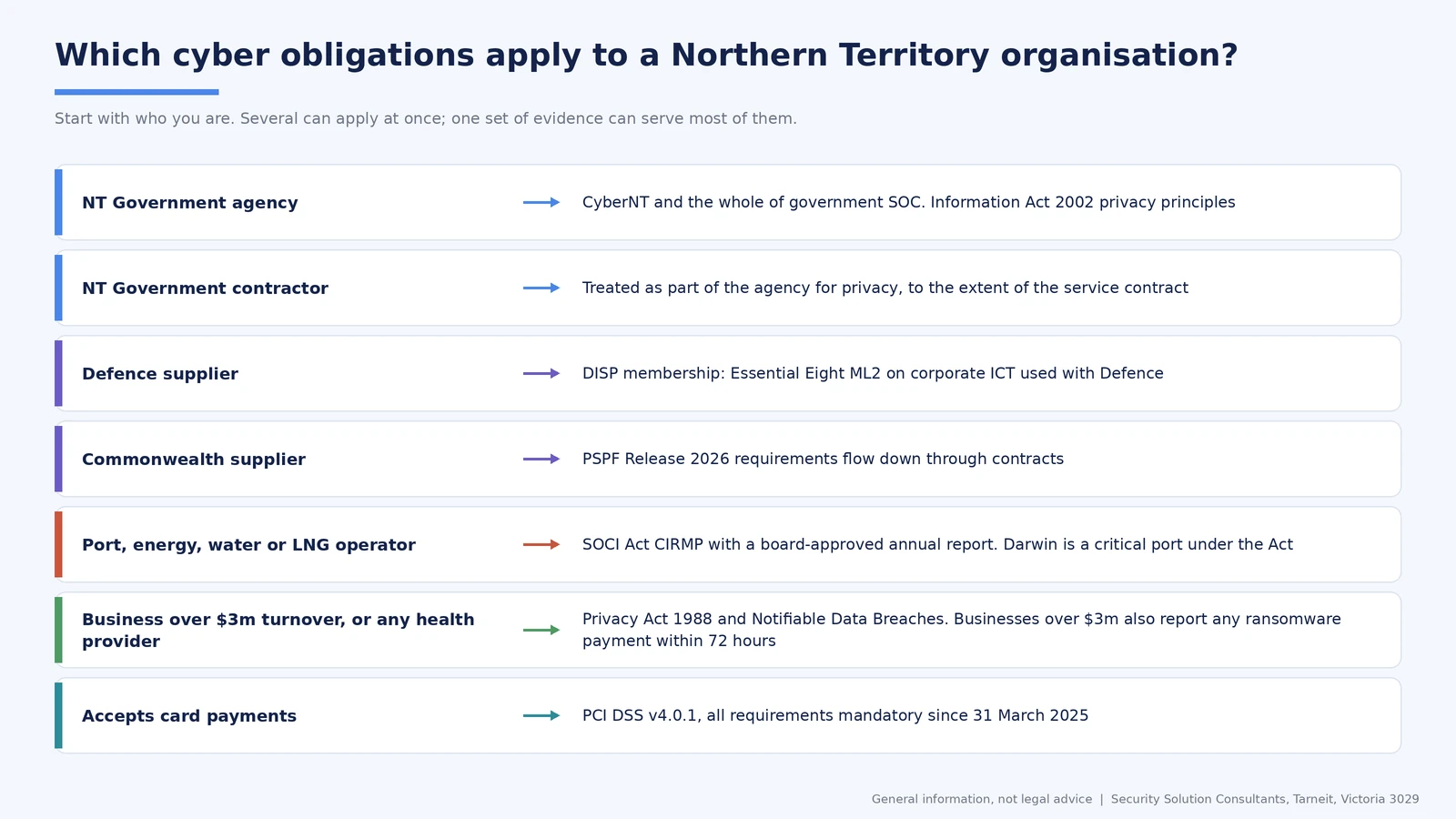
NT Government agencies and their contractors. Cyber security for the NT Government is coordinated by CyberNT within the Department of Corporate and Digital Development, which houses the government chief information security officer and a whole-of-government security operations centre. The NT Government’s cyber security policy is not published, so suppliers usually meet its expectations through contract clauses and security questionnaires rather than a public standard. Privacy is governed by the Information Act 2002 (NT) and its 10 Information Privacy Principles, which apply to public sector organisations. Contract service providers are treated as part of the organisation to the extent of their contract, so a private supplier holding agency data takes on the agency’s privacy obligations for that work.
What the Auditor-General reviews. The NT Auditor-General has examined individual government IT systems, including SerPro, the police system (November 2025), and GrantsNT and MOVERS (May 2024). Vendors who build or support Territory applications should assume their part of a system can fall within a review like these.
Two lessons from NT Health. During a 2019 system upgrade, 3,277 NT Health patient records were sent to a vendor, an incident reported in May 2023. On 8 October 2026 an NT Government network outage, which was not a hack, forced hospitals onto their continuity plans. The first is a third-party data handling problem. The second is a reminder that continuity plans get used for reasons other than cyber attacks.
Commonwealth and Defence work. Commonwealth entities operating in the Territory follow PSPF Release 2026, which keeps Essential Eight Maturity Level Two as the requirement for non-corporate Commonwealth entities. Defence suppliers work within the Defence Industry Security Program (DISP).
Critical infrastructure. The Port of Darwin and the Territory’s energy, gas and water operators carry SOCI Act obligations, covered below.
Private businesses. We are not aware of a Territory data breach notification scheme for private organisations. Those covered by the Privacy Act 1988 report under the Commonwealth Notifiable Data Breaches scheme, and businesses over $3 million turnover must report a ransomware payment within 72 hours under the Cyber Security Act 2024.
Certifications Darwin businesses ask us about
Top End buyers and prime contractors commonly ask for six things. This reflects typical demand, not a published Territory statistic.
- SOC 2. Darwin managed service providers and software firms with interstate or overseas customers are commonly asked for a SOC 2 report. A licensed CPA firm issues it; we prepare the controls and the evidence before the examination starts.
- ISO/IEC 27001. Defence and resources supply chains in the Territory commonly ask for it, and Defence states that ISO 27001:2022 can partly evidence DISP requirements. We implement the management system and run the internal audit; an accredited certification body issues the certificate.
- ISO/IEC 42001. Still a newer request in Darwin. It matters most to vendors selling AI tools to Commonwealth agencies, which work under the Policy for the responsible use of AI in government v2.0 from 15 December 2025. That policy does not require 42001, but a certified AI management system is one clear way to show buyers your AI is governed.
- ISO 9001. Construction, maintenance and engineering contractors bidding for northern Defence base works and for LNG and port projects are commonly asked for certified quality management.
- ISO 22000. Food businesses supplying Defence sites, resources camps and Top End hospitality are commonly asked by larger buyers for ISO 22000 or FSSC 22000.
- Critical infrastructure security. Port, energy, gas and water operators, and the contractors that maintain their operational technology, need controls that support a SOCI risk management program.
Critical infrastructure in the Northern Territory
The Port of Darwin is one of the critical ports covered by the SOCI Act. Landbridge has operated it under a 99-year lease since 2015. Around 1 May 2026 Landbridge began international investment arbitration through ICSID, and on 21 May 2026 the government said it would defend the claim. Whatever the outcome, the port remains a critical asset under the SOCI Act, so its risk management program and incident reporting continue to matter, as do the expectations placed on stevedores, logistics firms and IT providers working inside its systems.
Power and Water Corporation, owned by the NT Government, runs electricity networks, gas and water services. At Bladin Point, INPEX operates the Ichthys LNG plant, and Darwin LNG shipped its first Barossa cargo on 25 January 2026. These are operational technology environments where availability comes first and where third-party remote access needs close attention.
The enhanced CIRMP rules commenced on 10 June 2026, with some items phased in after 12 and 24 month grace periods, and responsible entities still owe a board-approved annual report by 28 September. Our SOCI compliance advisory and critical infrastructure and OT security training are built for these environments, and our note on the enhanced CIRMP rules sets out the timing.
Our services in Darwin
- SOCI Act CIRMP design and audit for port, energy, gas and water operators and their suppliers.
- DISP preparation across governance, personnel, physical, and ICT and cyber security, ahead of Defence’s own assessment.
- Essential Eight assessment with mapping to ASD Essentials, including its operational technology chapter.
- ISO 27001 implementation, SOC 2 readiness and ISO 9001 and ISO 22000 consulting for Territory suppliers.
- Information Act privacy reviews for contract service providers that hold NT Government personal information.
- Business continuity and incident response planning that assumes networks, power or a key supplier can fail at the same time.
- Energy sector security assessment for network, gas and generation operators.
Defence, LNG and the Port of Darwin
Three sectors shape the Top End’s security work, and they share many of the same suppliers.
Defence. The Marine Rotational Force Darwin numbers about 2,000 personnel in 2026, and the 2026 National Defence Strategy sets aside $13 to $16 billion over a decade to harden northern bases. That spending flows to builders, maintainers, ICT providers and caterers, many of whom will be asked for DISP membership or Essential Eight Maturity Level Two on the systems they use with Defence. Defence grants DISP membership at Entry Level, Level 1 (PROTECTED), Level 2 (SECRET) or Level 3 (TOP SECRET); we prepare you for its assessment.
LNG and energy. Ichthys and Darwin LNG run complex OT environments supported by long chains of engineering, maintenance and IT contractors. Those contractors are commonly asked for ISO 27001 certification, secure remote access and clear incident reporting arrangements. ASD Essentials now includes an operational technology chapter, which gives operators and suppliers a shared reference point.
The port. Port users, from stevedores to freight forwarders, connect to port systems and carry part of the port’s risk. When a responsible entity reviews its CIRMP, supplier access is an obvious place to look.
We spend time on site in Darwin for this work, because OT environments, physical security and port systems are hard to assess from a screen.
From the Essential Eight to ASD Essentials
ASD released the ASD Essentials series on 15 October 2026, with chapters for enterprise IT, cloud and operational technology and guidance on transitioning from the Essential Eight. For Darwin’s energy, gas and port operators the OT chapter is the significant change, because the Essential Eight was written with enterprise IT in mind. Defence, the PSPF and many contracts still name the Essential Eight, so most organisations will report against both for a while. Read our ASD Essentials explainer.
GRCLens: one evidence base for the Territory
A Darwin contractor might answer to DISP, a SOCI operator’s supplier questionnaire and an ISO 27001 auditor in the same quarter. GRCLens holds the evidence once against a shared control set and reports it to each framework, which removes much of the repeat work.
Audits in Darwin and the NT
For an independent, point-in-time view, see our cyber security audit services for Darwin and the Northern Territory, covering Essential Eight, SOCI CIRMP, DISP readiness and ISO 27001 internal audits.
Penetration testing and security testing in Darwin
Penetration testing in Darwin and the Northern Territory has a strong operational technology dimension. The Port of Darwin is a critical port under the SOCI Act, Power and Water Corporation runs electricity, gas and water networks, and LNG facilities operate around Darwin Harbour. Testing those environments must be passive and safety first: architecture and segmentation review, remote and vendor access paths, and the boundary between corporate IT and the plant.
For Defence suppliers in the Top End, a penetration test confirms that the Essential Eight mitigations DISP requires are effective, not just configured. We also test web applications, internal networks and cloud and Microsoft 365 tenancies for Territory organisations, and run phishing simulations for workforces spread across remote sites. Secure code review and threat modelling are available for software built locally or for Territory agencies. Read more about our penetration testing services, or see cyber security audits in Darwin.
Frequently asked questions
Does the NT Government publish a cyber security policy its suppliers must follow?
Not publicly. CyberNT, within the Department of Corporate and Digital Development, coordinates government cyber security with a chief information security officer and a whole-of-government security operations centre, but the policy itself is not published. Suppliers usually see its requirements as contract clauses and questionnaires, so the contract is the document to work from.
We hold NT Government data under contract. Do Territory privacy rules apply to us?
Yes, to the extent of the contract. Under the Information Act 2002 (NT), a contract service provider is treated as part of the public sector organisation for the work it does under the contract, so the 10 Information Privacy Principles govern how you collect, use, store and disclose that personal information. The NT Health vendor incident, reported in May 2023, shows why agencies care.
Does the Port of Darwin arbitration change SOCI obligations for port suppliers?
No. The arbitration Landbridge began around 1 May 2026 does not change the port’s status: Darwin remains a critical port under the SOCI Act, so its risk management program, incident reporting and annual report duties continue. For stevedores, logistics firms and IT providers, the practical point is that the port’s security expectations of you carry on, whatever the outcome.
Which DISP level does a Darwin Defence supplier need?
That depends on the work. Levels run from Entry Level through Level 1 (PROTECTED), Level 2 (SECRET) and Level 3 (TOP SECRET), and your contract or prime will usually say which one is needed. Defence grants membership after its own assessment. We help you prepare, including reaching Essential Eight Maturity Level Two on the corporate ICT you use with Defence.
Do we need ISO 27001 to supply LNG or port operators in Darwin?
Not always. Operators set their own supplier requirements, and some accept a completed security questionnaire with evidence. ISO 27001 certification is commonly requested because it answers many questions at once and can partly evidence DISP. If you are asked for it, we build the management system and run the internal audit; an accredited certification body issues the certificate.
How does ASD Essentials affect Darwin energy and port operators?
ASD Essentials, published on 15 October 2026, includes an operational technology chapter alongside enterprise IT and cloud. That matters in Darwin, where ports, power, gas and water depend on OT. Obligations that name the Essential Eight, such as DISP and the PSPF, still use it for now, so operators should map current evidence to the new OT actions without abandoning the maturity model.
Next step
Tell us which contract, operator or regulator is asking and we will set out what applies and a fixed-scope way to meet it. Contact us or email info@secsolutionshub.com. We also work with organisations in Brisbane, Canberra and Melbourne.

