

As AI tools like Microsoft Copilot become embedded in enterprise workflows, traditional static governance policies are rapidly becoming obsolete. This blog explores how the proven adaptive risk model from Microsoft Purview can be applied to build a dynamic, context-aware AI governance framework — one that tightens controls precisely when risk rises, without impeding the productivity of legitimate users
The Governance Gap AI Has Created:
The arrival of Microsoft Copilot and generative AI tools across the enterprise has been transformative. Productivity is up, knowledge work is accelerating, and business units are finding new ways to leverage intelligence at scale. But for CISOs and IT leaders, this wave has also introduced a governance challenge that most organizations are not yet equipped to address.
Static AI governance policies — blanket rules applied uniformly across all users, all contexts, and all risk levels — were never designed for a world where a single prompt can surface confidential HR data, summarize a competitor analysis, or inadvertently expose a customer’s personal information.
The question is no longer whether to govern AI. It is how to govern it intelligently.
The Core Problem with Static Policies:
A policy that blocks Copilot access entirely kills productivity. A policy that permits unrestricted access invites data exfiltration. Neither extreme is acceptable. Organizations need a middle path — one that is responsive to actual risk, not assumed risk.
Lessons from Purview: The Adaptive Protection Model
Microsoft Purview’s Adaptive Protection already solves a version of this problem in the data loss prevention (DLP) space. Rather than applying uniform DLP rules to every user, it uses behavioral signals and insider risk analytics to dynamically assign risk levels — low, medium, or high — and then automatically adjusts enforcement based on those levels.
The result is a governance model that is always-on but never disruptive. Normal users operate without friction. Users whose behavior signals risk face progressively tighter controls — automatically, in real time, without manual intervention.
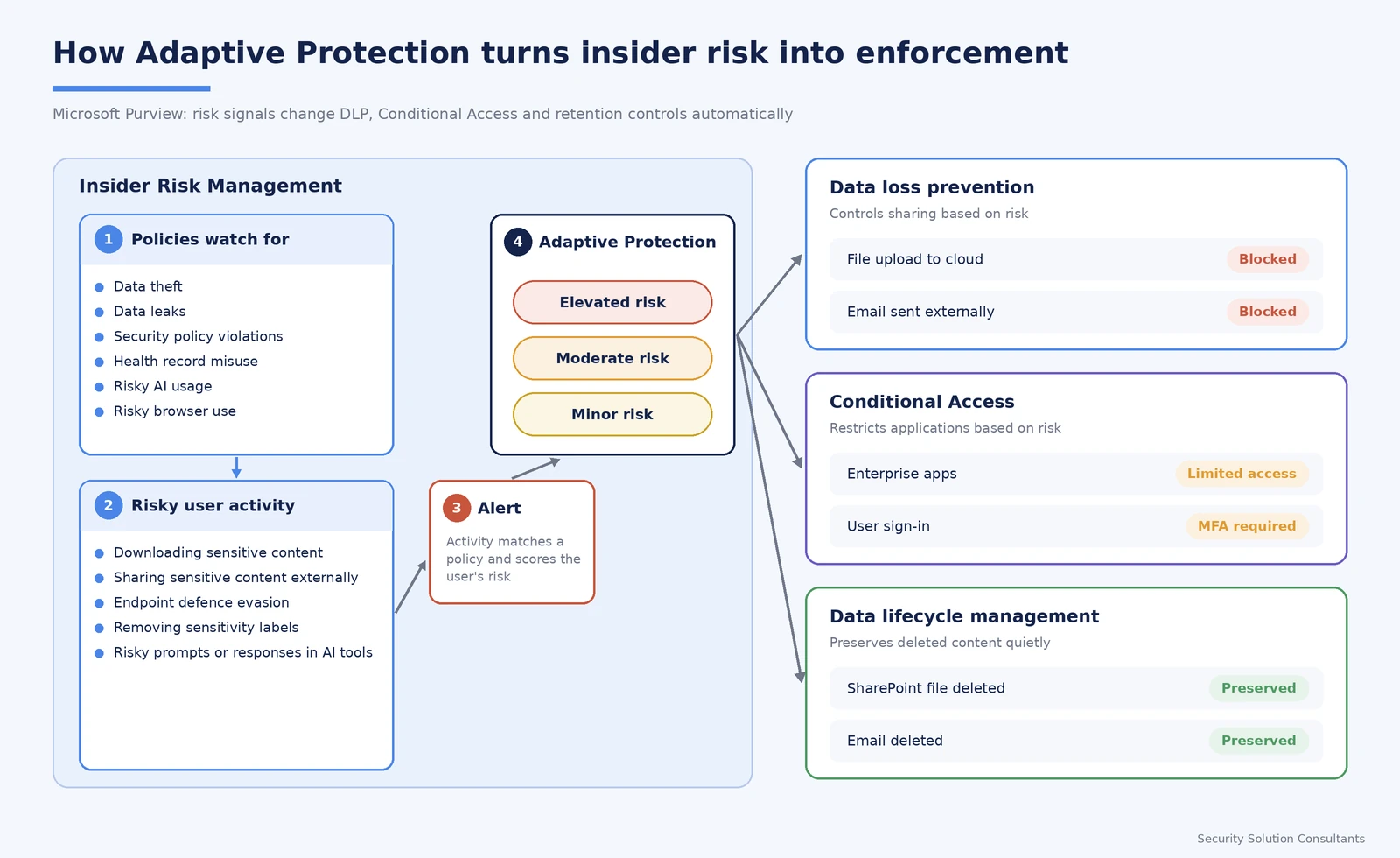
How Adaptive Protection Works in Purview
- Behavioral signals are continuously monitored — unusual data access, mass downloads, policy violations
- An insider risk score is calculated and updated dynamically per user
- DLP policies automatically adjust enforcement based on the current risk tier
- High-risk users face stricter controls; low-risk users experience no change
- The system is self-correcting — risk scores fall when behavior normalizes
Within Microsoft Purview, Adaptive Protection uses signals from user activity, insider risk indicators, and behavioral analytics to dynamically assess a user’s risk level (e.g., low, medium, high). When a user is flagged as high risk based on anomalies such as unusual data access, mass downloads, or policy violations, DLP policies automatically adjust enforcement levels.
This means stricter controls are applied in real time—such as blocking data sharing, restricting downloads, or requiring justification for sensitive actions. The system continuously evaluates behavior, ensuring policies are context-aware and adaptive rather than static.
As a result, organizations can proactively prevent data exfiltration by tightening controls only when risk increases, without impacting normal user productivity.
Applying the Model to AI Governance
The architectural logic of Adaptive Protection maps directly onto the challenge of governing AI tool usage. The signals change. The enforcement mechanisms change. But the underlying principle — dynamic, risk-responsive control — translates perfectly.
The Parallel Framework
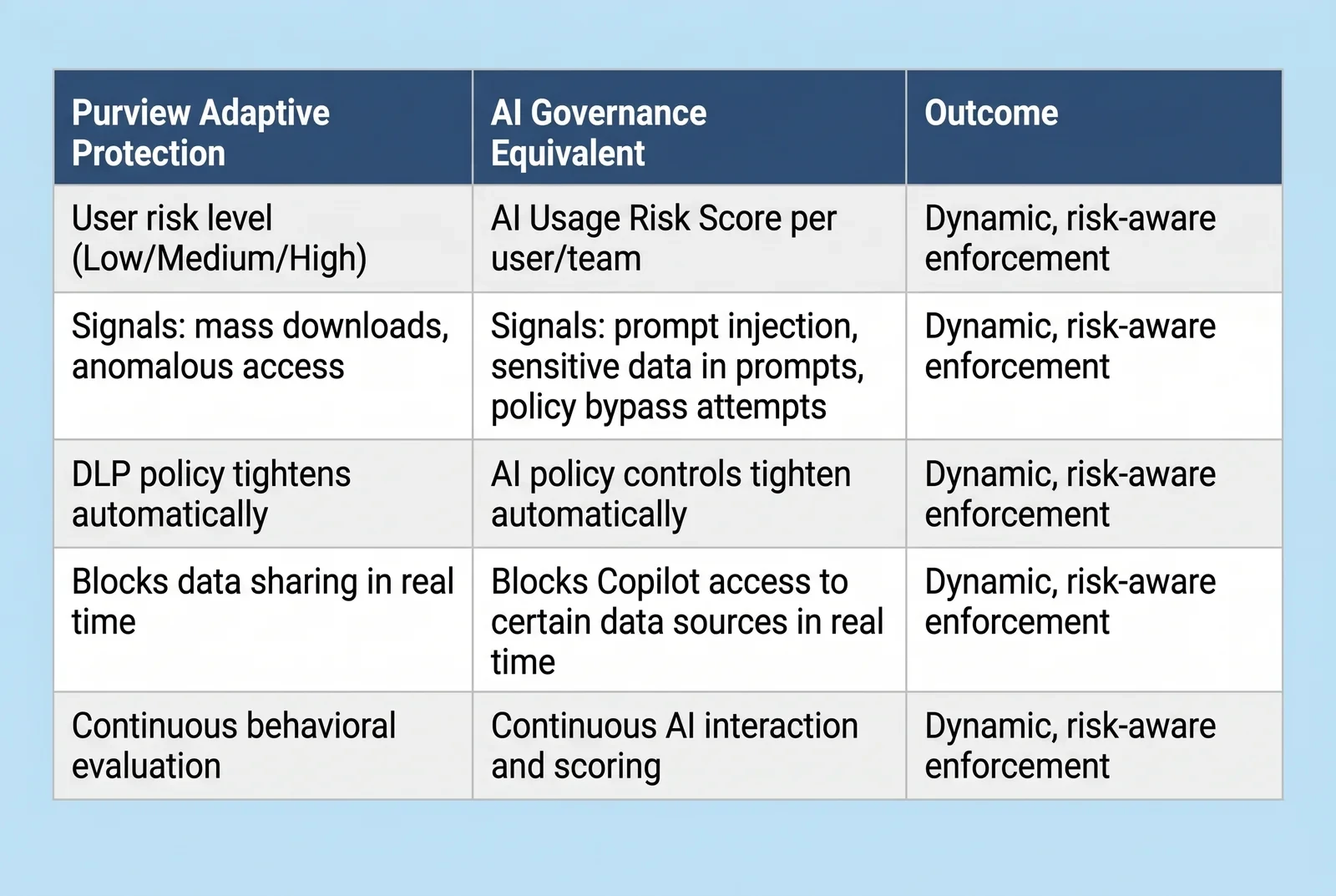
The critical insight here is that AI governance does not need to be reinvented from scratch. The risk-intelligence infrastructure that Purview has already built — insider risk scoring, behavioral analytics, sensitivity label enforcement — can be extended and applied to AI tool access and behavior.
Risk Signals Specific to AI Tools
Just as Purview monitors for data exfiltration signals, a risk-responsive AI governance layer must define and monitor for AI-specific behavioral signals. These fall into four categories:
Prompt-Level Signals
- Repeated attempts to extract confidential documents via Copilot prompts
- Instructions designed to bypass AI safety boundaries or system prompts
- Queries targeting data the user would not ordinarily access through conventional means
- Unusual prompt volume or complexity patterns outside the user’s baseline
Output Misuse Signals
- AI-generated content bulk-exported or shared to external channels
- Copilot outputs pasted into unapproved or unmonitored platforms
- Automated workflows triggered from AI outputs without review gates
Data Exposure Signals
- Copilot surfacing data beyond the user’s normal access scope — privilege escalation via AI
- Sensitive labelled content referenced in Copilot responses without justification
- Cross-tenant data referenced in multi-tenant or partner environments
Shadow AI Signals
- Attempts to access unapproved AI tools or browser-based AI on corporate devices
- API calls to non-sanctioned AI providers from corporate infrastructure
- Repeated dismissal of AI usage justification prompts or policy acknowledgments
Dynamic Enforcement Tiers
Rather than a binary allow/deny policy for AI tools, a risk-responsive framework operates across three enforcement tiers that adjust automatically as a user’s risk score changes.
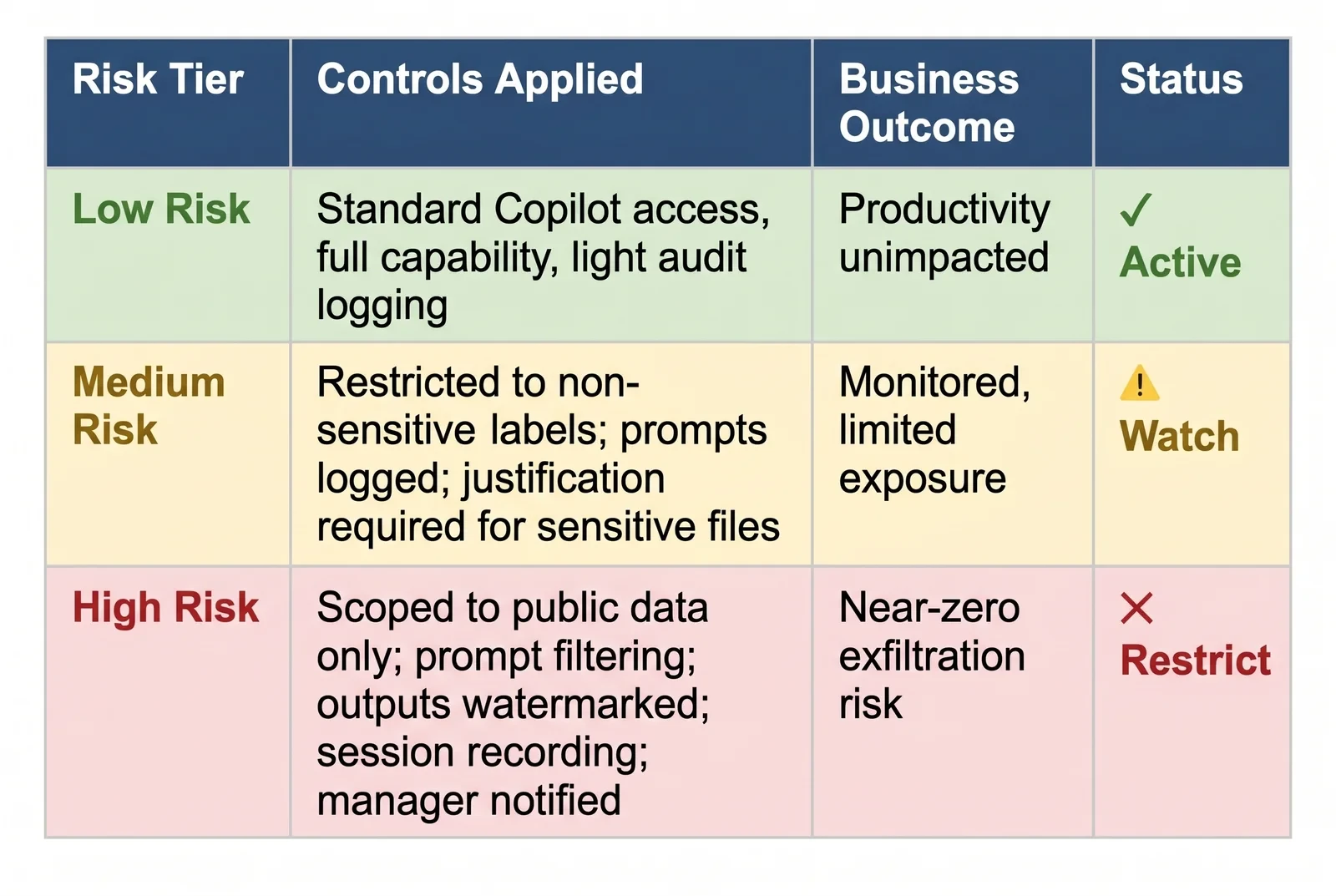 Crucially, movement between tiers is bidirectional. As risk scores normalize — because behavior changes, or because a flagged incident is resolved — controls automatically relax. This prevents the governance layer from becoming a permanent productivity barrier for users who triggered a transient risk event.
Integration Points in the Microsoft Ecosystem
For organizations already invested in the Microsoft security stack, the integration points to build this model exist today. They require configuration and intent, not new infrastructure.
Microsoft Purview Insider Risk Management
Risk scores generated by Insider Risk Management can feed directly into Conditional Access policies. When a user’s risk score crosses a defined threshold, Conditional Access can automatically gate or scope their Copilot for Microsoft 365 access — no manual intervention required.
Sensitivity Labels and Copilot Scoping
Microsoft Purview sensitivity labels control what data Copilot can reference and summarize. In a risk-responsive model, the label-based access rules applied to a user’s Copilot session can change dynamically based on their risk tier — restricting access to Confidential and Highly Confidential labelled content when risk is elevated.
Communication Compliance
Communication Compliance policies can monitor Copilot interactions — prompts and responses — for policy violations. Violations feed back into the insider risk model, creating a closed-loop system where AI misuse directly influences the risk score and the enforcement response.
Microsoft Entra ID (Conditional Access)
Conditional Access policies in Entra ID can be configured to restrict, suspend, or scope Copilot sessions in real time based on risk signals. Combined with Continuous Access Evaluation (CAE), this means risk-based enforcement can take effect within minutes of a signal being detected — not at the next sign-in event.
The Strategic Imperative for CISOs
AI governance is rapidly becoming a board-level concern. Regulators are beginning to scrutinize how organizations govern AI tool usage, particularly around data handling, bias, and accountability. The EU AI Act, emerging SEC guidance on AI risk disclosure, and sector-specific frameworks are all moving in the same direction: organizations will be expected to demonstrate that AI is governed with the same rigor as any other enterprise risk vector.
Static policies will not satisfy this scrutiny. A policy document that says ‘AI tools must be used responsibly’ is not a governance framework. It is a liability.
A risk-responsive AI governance framework, built on the adaptive protection model, provides something that static policies cannot: evidence of continuous, proportionate, automated enforcement. It demonstrates to auditors, regulators, and boards that governance is operational — not aspirational.
The CISO’s Value Proposition
Risk-responsive AI governance enables CISOs to say with confidence: our AI controls are always on, always proportionate, and always evidenced. We do not block productivity. We apply controls where risk dictates — and we have the logs to prove it.
A Practical Roadmap for IT Leaders
Building a risk-responsive AI governance framework does not require a big-bang transformation. A phased approach allows organizations to build capability progressively while delivering value at each stage.
Phase 1 — Foundation (0–3 months)
- Enable Microsoft Purview Insider Risk Management and establish baseline behavioral profiles
- Classify and apply sensitivity labels to data assets that Copilot can access
- Define AI-specific risk signals and configure Communication Compliance policies to monitor Copilot interactions
- Establish audit logging for all Copilot prompts and responses
Phase 2 — Integration (3–6 months)
- Connect Insider Risk Management risk scores to Conditional Access policies
- Configure Copilot access scoping rules based on sensitivity label tiers
- Implement automated risk-tier enforcement — medium and high risk policy gates
- Build a governance dashboard for the security operations team
Phase 3 — Maturity (6–12 months)
- Introduce AI-specific insider risk indicators into the Purview risk model
- Automate justification workflows for sensitive AI actions
- Develop a regulatory evidence pack — audit trails, enforcement logs, policy documentation
- Extend the framework to cover non-Microsoft AI tools through Defender for Cloud Apps (CASB)
Conclusion: Governance Must Evolve with the Threat
The organizations that will navigate the AI era successfully are not those that restrict AI the most aggressively, nor those that deploy it without constraint. They are the ones that govern it intelligently — with controls that are proportionate, adaptive, and evidenced.
The adaptive protection model that Microsoft Purview has proven in the DLP space offers a clear blueprint. The risk intelligence infrastructure already exists. The enforcement integration points are available. What is required now is the strategic decision to apply them — to extend the same dynamic, risk-responsive thinking that protects enterprise data to the AI tools that are reshaping how that data is accessed, synthesized, and shared.
Static policies were built for a static world. The AI-enabled enterprise is anything but static. It is time for governance to catch up.
Read more blogs related to AI and GRC https://www.secsolutionshub.com/blog/

