

Update, October 2026: ASD has published ASD Essentials, the Essential Eight replacement. Read what changes and how to move your Essential Eight work across.
Table of Contents
- What Is the Essential Eight and Why Does It Matter?
- The 8 Controls What You’re Actually Implementing
- Essential Eight Maturity Level 1: Starting Point Only
- Essential Eight Maturity Level 2: The Real Baseline
- Essential Eight Maturity Level 3: When You Actually Need It
- Level 2 vs Level 3: Side by Side
- Which Level Does Your Business Actually Need?
- What Happens If You Don’t Meet the Required Level?
- Common Mistakes When Implementing Essential Eight
- How Sec Solutions Hub Helps Australian Businesses
- Conclusion
- FAQs
What Is the Essential Eight and Why Does It Matter?
The Essential Eight is a set of eight prioritized cybersecurity controls developed by the Australian Signals Directorate’s Australian Cyber Security Centre. It’s the most widely used cybersecurity framework in Australia, referenced by government agencies, cyber insurers, enterprise procurement teams, and regulators alike. The ASD maturity model assigns each control a maturity level from 0 to 3. Level 0 means no meaningful protection. Level 3 means controls are deeply integrated, tested, and operating effectively against sophisticated adversaries. The ACSC Essential Eight compliance requirement applies to every Australian organization connecting to government networks or supplying government entities, and increasingly, to private businesses in regulated industries. And here’s the critical point most businesses miss: you need to achieve the same Essential Eight maturity level across all eight controls before advancing. Patchy implementation, strong in some controls, weak in others, leaves gaps that attackers actively look for.The 8 Controls: What You’re Actually Implementing
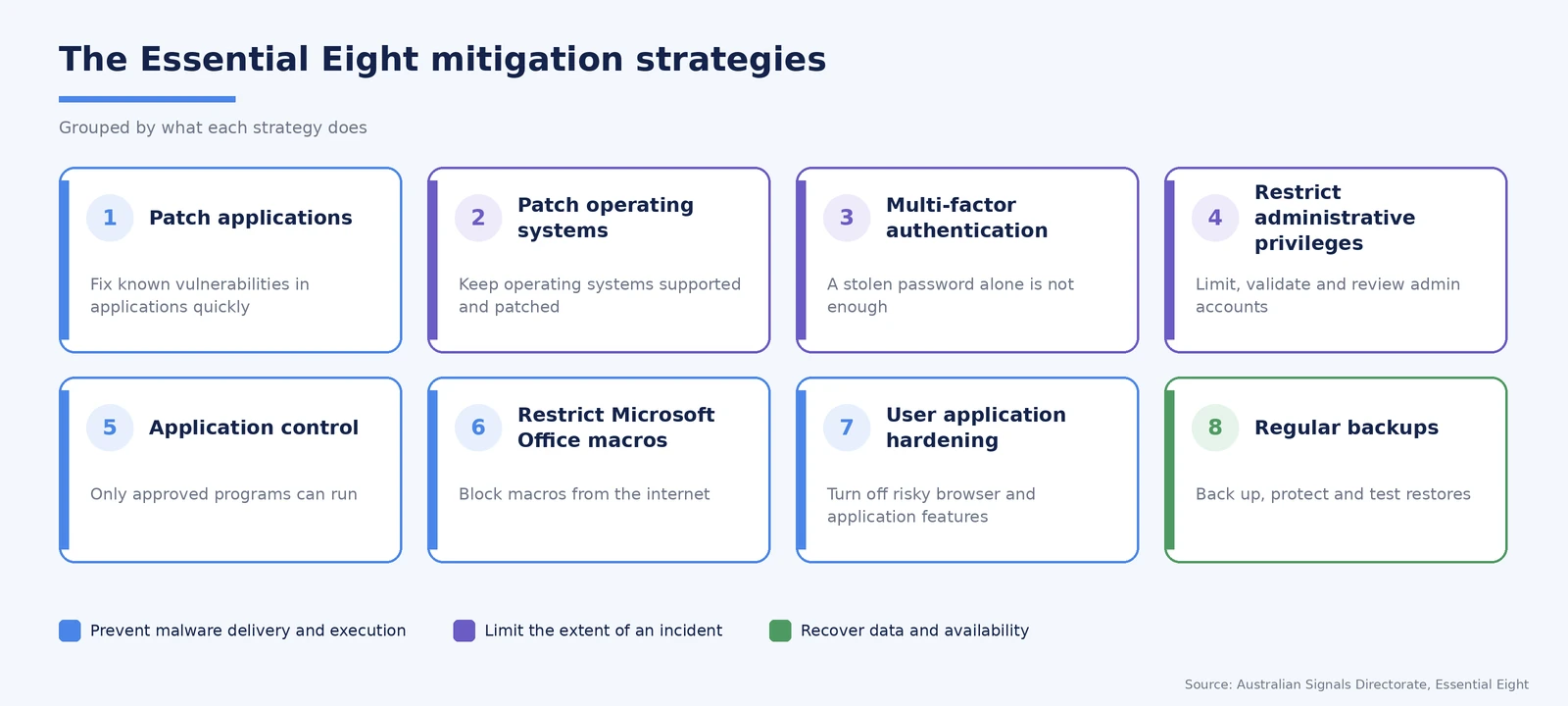 Before comparing levels, here’s what you’re actually implementing across each control.
- Patch Applications: keeping software updated to close known vulnerabilities. One of the most common attack entry points.
- Patch Operating Systems: updating OS across all devices. Unpatched systems are an open door for ransomware.
- Multi-Factor Authentication: adding a second verification step beyond passwords. Stops credential theft attacks cold.
- Restrict Administrative Privileges: limiting who has admin access and when. Reduces the blast radius when credentials are compromised.
- Application Control: preventing unapproved applications from running. Stops malware execution at source.
- Configure Microsoft Office Macro Settings: blocking malicious macros in Office documents. A common ransomware delivery vector.
- User Application Hardening: disabling unnecessary browser features and blocking web-based attacks.
- Regular Backups: daily backups tested for restoration. Your last line of defence against ransomware.
Essential Eight Maturity Level 1: Starting Point Only
Level 1 protects against opportunistic attackers using common tools, mass phishing campaigns, automated scanning, and exploiting unpatched software. It’s appropriate only as a starting point, not a destination. At Level 1, most controls are drafted but applied inconsistently. Evidence is patchy. Processes exist on paper but aren’t enforced reliably across all systems. If your business is just beginning its cybersecurity program, Level 1 is where you start, but you should be actively planning to reach Level 2 within 12 months.Essential Eight Maturity Level 2: The Real Baseline
Level 2 is the Essential Eight maturity level that matters most for the majority of Australian businesses in 2026. It defends against adversaries who invest time and effort to bypass basic controls, targeted phishing, credential-based attacks, and focused intrusion attempts.What Level 2 Actually Requires
Controls are enforced across all systems and regularly reviewed, not just deployed and forgotten. The key differences from Level 1 at each control are tighter timeframes, broader coverage, and consistent evidence. Patching: internet-facing services patched within 48 hours of a patch release, all others within two weeks. MFA: required for all privileged accounts and all remote access, not just some. Admin privileges: reviewed at least annually, no admin accounts used for daily work. Application control: extended to workstations with centralized logging of all events. Backups: daily backups with monthly tested restoration.Who Needs Level 2 in 2026
Level 2 is mandatory for all local non-corporate Commonwealth entities under the Protective Security Policy Framework, effective from July 2022. That’s not optional for government entities. It’s a hard requirement. But it doesn’t stop there. ACSC has solidified its position: Level 2 is the expected baseline for mid-sized local businesses, service providers, and any organization handling sensitive customer data. Cyber insurers reference it in vendor due diligence before issuing or renewing cover. Enterprise customers include it in procurement requirements. And the ACSC states that organizations implementing all eight controls at Level 2 or higher are protected against approximately 95% of cyber incidents targeting local organizations. If you’re an the country’s SME with government contracts, financial services clients, or sensitive customer data, Level 2 is your minimum in 2026.Essential Eight Maturity Level 3: When You Actually Need It
Level 3 is the top of this maturity level scale. It protects against highly skilled, persistent adversaries, state-sponsored actors, advanced threat groups conducting extensive reconnaissance, developing custom malware, and using sophisticated evasion techniques.What Level 3 Actually Requires
Controls are not just enforced; they’re deeply integrated into security operations and tested for effectiveness. That’s a meaningful distinction. At Level 2, you enforce controls and review them. At Level 3, you actively test whether they work against realistic adversary scenarios. Think red team exercises, adversary simulation, SIEM integration, and active threat hunting, not just log retention. Patching at Level 3: all systems patched within 48 hours, not just internet-facing services. MFA: phishing-resistant MFA for all users accessing sensitive systems, not just remote and privileged access. Admin privileges: just-in-time access models, reviewed regularly. Backups: tested quarterly with full restoration validation.Who Needs Level 3 in 2026
Level 3 is required for organizations in defence supply chains, critical infrastructure operators, and those handling classified or highly sensitive government data. The ACSC is placing stronger scrutiny in 2026 on MFA, privilege management, and patching discipline, especially for organizations supporting Defence, procurement, and critical infrastructure ecosystems. If you work with Defence, operate energy or utilities infrastructure, or hold contracts requiring security clearances, Level 3 is your target.Level 2 vs Level 3: Side by Side
| Control | Level 2 | Level 3 |
|---|---|---|
| Patch Applications | 48hr internet-facing, 2 weeks for others | 48hr all systems |
| Patch OS | 2 weeks for critical vulnerabilities | 48 hours for all vulnerabilities |
| MFA | All privileged + remote access | All users, phishing-resistant |
| Admin Privileges | Restricted, reviewed annually | Just-in-time, reviewed regularly |
| Application Control | Workstations + centralized logging | All systems + automated testing |
| Backups | Daily, tested monthly | Daily, tested quarterly with validation |
| Monitoring | Event logs 12 months retention | SIEM integration + active threat hunting |
| Who Needs It | Most domestic businesses | Defence, critical infrastructure, government |
Which Level Does Your Business Actually Need?
 Use this decision framework. Answer honestly.
- Are you a Commonwealth entity or government supplier? → Level 2 minimum, likely Level 3 depending on data sensitivity
- Do you handle sensitive customer data? → Level 2 minimum
- Are you in the defence supply chain? → Level 3
- Do you operate critical infrastructure? → Level 3
- Does your cyber insurer reference Essential Eight? → Level 2 minimum
- Are you an SME with no government contracts? → Level 1 to Level 2 depending on data risk
- Do enterprise clients include security requirements in contracts? → Level 2
What Happens If You Don’t Meet the Required Level?
The consequences are real, and they’re landing on local businesses right now.- Cyber insurance rejected. Insurers increasingly require proof of Level 2 before issuing or renewing cover. If you suffer a breach and weren’t at the required level, your claim can be denied. That $97,200 average incident cost lands entirely on you.
- Government contracts lost. Commonwealth procurement teams are checking compliance. If you’re a supplier and can’t demonstrate the required framework level, you lose the contract, or don’t win it in the first place.
- ACSC audit findings. For regulated entities, a formal ACSC assessment finding that you’re below the required level triggers a remediation requirement with a timeline. Ignore it and enforcement follows.
- Breach liability. Under the Privacy Act, a breach caused by preventable control failures creates regulatory exposure. Demonstrating you weren’t at the required level makes that exposure worse.
Common Mistakes When Implementing Essential Eight
These are the patterns that show up in almost every compliance framework gap assessment we run.- Uneven implementation across controls. High maturity on MFA, low maturity on patching. This doesn’t give you the higher level; it gives you the lower one with a dangerous false sense of security.
- Confusing deployed with enforced. Having a patching policy isn’t Level 2. Having enforced patching with evidence that all systems were patched within the required timeframe is Level 2. Auditors ask for evidence, not policies.
- Treating it as a one-time project. Essential Eight is a continuous program. Controls drift. Systems change. Staff turns over. Essential Eight implementation Australia-wide is an ongoing discipline, not a checkbox. Monthly reviews, regular testing, and continuous monitoring are what keeps you at your target level.
- Skipping the gap assessment. Most businesses guess their current level. A structured Essential Eight gap assessment tells you exactly where you sit, what’s missing, and what to prioritize, before an auditor or insurer tells you.
How Sec Solutions Hub Helps Local Businesses
Sec Solutions Hub delivers structured Essential Eight uplift advisory for domestic businesses, from initial gap assessment through to ongoing compliance maintenance via GRCLens. Our Cyber Security Maturity Assessment service maps your current position against the ACSC assessment methodology across all eight controls and all three levels, giving you a scored report with a prioritized remediation roadmap. Not a generic template. A business-specific cyber security maturity assessment that Australian businesses can act on, based on your actual environment. GRCLens then automates the ongoing monitoring, tracking control status, collecting evidence, and keeping your compliance position current year-round, rather than rebuilding everything before each assessment. Our Security Compliance and Enterprise Risk Management services integrate Essential Eight into your broader compliance and risk framework, connecting it to ISO 27001, APRA, and the Cyber Security Act 2024 where relevant.Conclusion
The difference between your compliance level 2 and Level 3 isn’t complexity for its own sake; it’s the threat level your business actually faces. Most of the country’s businesses need Level 2. Defence suppliers, critical infrastructure operators, and government agencies need Level 3. And nobody should be sitting at Level 1 in 2026 and calling it done. Know your required level. Close your gaps consistently across all eight controls. And build a compliance program that maintains your position continuously, not just at assessment time. Book a free structured gap assessment consultation today to find out exactly which level your business needs and where the gaps are before an insurer or auditor does.FAQs
- What is the difference between Essential Eight Level 2 and Level 3?
- Is Essential Eight Level 2 mandatory for local businesses?
- How long does it take to achieve Essential Eight Level 2?
- Do SMEs need Essential Eight Level 3?
- How do I assess my current target level?
Conclusion: How Security Solutions Consulting Can Help
Moving from Maturity Level 0 to Level 2 or Level 3 requires more than policy documentation — it requires verified technical controls, governance processes, and evidence of operational effectiveness. SSC’s Essential Eight specialists have guided ASX-listed companies, government agencies, and critical infrastructure operators through every maturity level, delivering sustainable uplift rather than point-in-time compliance.
GRCLens — GRCLens provides continuous Essential Eight maturity visibility — tracking your level across all eight controls, flagging gaps as they emerge, and generating the evidence your auditors and leadership need automatically.
Ready to uplift your Essential Eight maturity? Contact our team for a free, no-obligation consultation. We will assess your current position and provide a clear, prioritised roadmap tailored to your organisation.
Explore: Essential Eight Advisory | Maturity Assessment | ISO 27001 Advisory | GRCLens Platform | Get in Touch
Need help putting this into practice? See our Essential Eight compliance and assessment services — including independent gap assessment, Maturity Level 2 uplift, and planning for ASD’s new Essentials series.

