
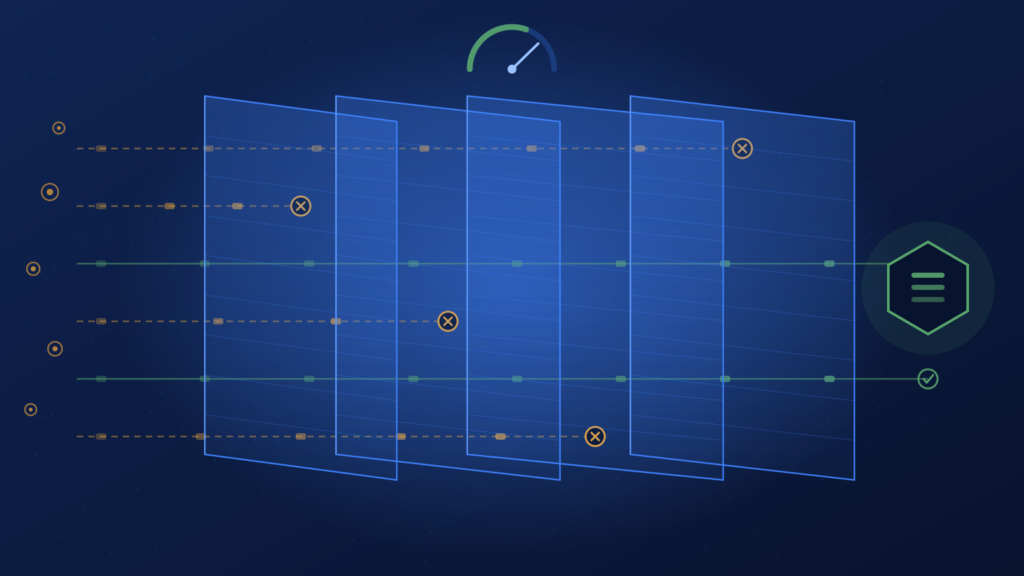
In practice, policy management asks: Can we manage and change our network security rules efficiently — with accuracy, speed, and without introducing risk? Below, we break down network security policy management in practical terms.
Also, posture management asks: Do those controls, in their current state, actually create the security posture we intend — or have accumulated rules created gaps we cannot see?
Both questions matter. However, they are fundamentally different, and conflating them is why so many enterprises discover — during a penetration test or a breach — that a firewall rule put in place five years ago has been quietly undermining their security architecture ever since.
Notably, this guide is for CISOs, network security engineers, and GRC teams across Australia, New Zealand, and APAC who are ready to move from managing rules to owning their posture.
What Is Network Security Policy Management (NSPM)?
Network Security Policy Management (NSPM) is the discipline — which draws on tooling, process and governance — of designing, implementing, reviewing, and changing network security controls in a way that is accurate, auditable, and operationally sustainable. In practice, NSPM covers:
- Firewall rule lifecycle management — from request through change approval, implementation, validation, and periodic review
- Policy harmonisation — ensuring rules across heterogeneous environments (on-prem firewalls, cloud security groups, SDN, zero-trust proxies) reflect a single coherent intent
- Risk-aware change management — assessing the blast radius of a proposed rule change before it goes live
- Audit readiness — producing evidence that controls are designed and operating effectively, as required by ISO 27001, PCI DSS, Essential Eight, and SOC 2
Importantly, the policy management question is operational: Can you change the right rule, on the right device, at the right time, with the right approval, and prove it?
Network security policy: What Is Network Security Posture Management?
Network Security Posture Management extends beyond individual rule changes. It asks whether the totality of your network controls — across all devices, all environments, all rule sets — actually reflects your intended security design.
By contrast, the gap between intended posture and actual posture is where breaches live.
In addition, the most common scenarios we see with enterprise clients across APAC:
| Scenario | How It Happened | Posture Impact |
|---|---|---|
| Orphaned vendor access | Someone opened a PoC in 2021. The vendor left. Their rule stayed. | Persistent lateral movement path into core network |
| Project rule never closed | Temporary access granted for a migration. Project ended. Rule forgotten. | Internet-to-internal path bypassing segmentation |
| M&A rule entropy | Merger combined two networks. Contradictions no one reviewed. | Unknown attack surfaces across merged environments |
| Cloud migration legacy rules | On-prem rules replicated into AWS security groups. | Cloud exposure far wider than security team believes |
Why Most Organisations Have Neither — Fully
| Symptom | Root Cause |
|---|---|
| Thousands of unreviewed rules | No systematic policy lifecycle management |
| “We have 60,000 rules and don’t know what half do” | No posture visibility; rule entropy accumulates over years |
| Breach via a path that “should have been blocked” | Gap between intended and actual posture |
| Compliance evidence assembled manually at audit time | No continuous control validation |
| Change requests take 2–3 weeks and often break things | No risk-aware change management process |
| Cloud migration exposed legacy rules in new attack surfaces | Policy not translated into cloud-native controls |
Network security policy in practice: The NSPM Maturity Spectrum
Most enterprise clients we engage across APAC sit at Level 1.5 to 2.5. Also, a structured NSPM engagement targets Level 3 within 90 days and Level 4 over 12 months.
Level 1 — Ad Hoc
Rules managed manually via CLI. No central visibility. Audits rely on tribal knowledge.
Level 2 — Documented but Disconnected
Change process exists in ITSM but logs and devices diverge over time. Annual reviews at best.
Level 3 — Tool-Assisted
NSPM platform provides rule visibility, change workflow, and risk analysis. Periodic posture review.
Level 4 — Continuous and Integrated
Rules validated against intended design in near real-time. Deviations flagged automatically. In addition, evidence generated continuously for audit and compliance — integrated with GRCLens.
Compliance Framework Obligations
NSPM is not just a security hygiene exercise — it is a compliance obligation under every major framework in Australia, New Zealand, and APAC:
- ISO 27001:2022 — Annex A Controls 8.20–8.22 and 8.9 require documented, reviewed, and enforced controls throughout their lifecycle
- ASD Essential Eight — Network segmentation and lateral movement restriction must be actually enforced, not just documented. ACSC Essential Eight →
- PCI DSS v4.0 — Requirement 1 requires documented rule sets, biannual reviews, and evidence that rules are justified and current. PCI SSC →
- SOC 2 (CC6.6, CC6.7) — Requires logical access security infrastructure to protect against external threats, evidenced continuously
- NZISM / PSPF — Network security controls must be documented, reviewed, and validated. NZISM →
- SOCI Act / CIRMP — Australia’s Security of Critical Infrastructure Act requires active posture management for critical infrastructure operators. SOCI Act →
Network security policy: What an SSC NSPM Engagement Looks Like
Phase 1 — Discovery and Baseline (Weeks 1–3): We collect and analyse your current rule sets across all in-scope devices and environments. In practice, we map what you have against what you intend and produce a baseline posture assessment covering total rule count, high-risk rules, exposed paths between critical assets, and compliance gaps.
Crucially, phase 2 — Remediation and Policy Design (Weeks 4–8): We design the target policy — the rule set that reflects your actual security intent. Notably, we prioritise remediation by risk, manage change through your approved process, and validate each change against the target posture. Importantly, we design or improve your NSPM operational process: rule lifecycle, review cadence, risk-scoring criteria, and approval workflows.
Specifically, phase 3 — Tooling, Integration & Continuous Validation (Weeks 9–12+): We integrate GRCLens NSPM to provide continuous posture visibility, automated rule review triggers, and change risk assessment — so network security controls are evidenced continuously, not just at audit time.
The Business Case: Why NSPM Now
The average cost of a data breach in Australia in 2025 was AUD 4.26 million (IBM/Ponemon). Overall, organisations with mature NSPM capability report 40–60% reduction in audit preparation time. Also, network change turnaround drops from weeks to days with proper NSPM tooling. In addition, cyber insurers and SOCI/PSR regulators now require demonstrable, continuous network security governance.
Overall, further reading: ACSC Annual Cyber Threat Report → | Gartner on NSPM →
Introducing GRCLens NSPM — Built by SSC, for APAC Organisations
Security Solutions Consulting has developed GRCLens — a purpose-built Network Security Policy and Posture Management platform. In practice, unlike bolt-on integrations, our team built GRCLens from the ground up to address the specific challenges facing multi-vendor enterprise environments across APAC. Notably, it serves three distinct audiences simultaneously: operations teams who need rule-level detail. management who need risk-prioritised findings. and executive leadership who need posture scores and compliance percentages at a glance.
Dashboard — Executive & Management Posture at a Glance
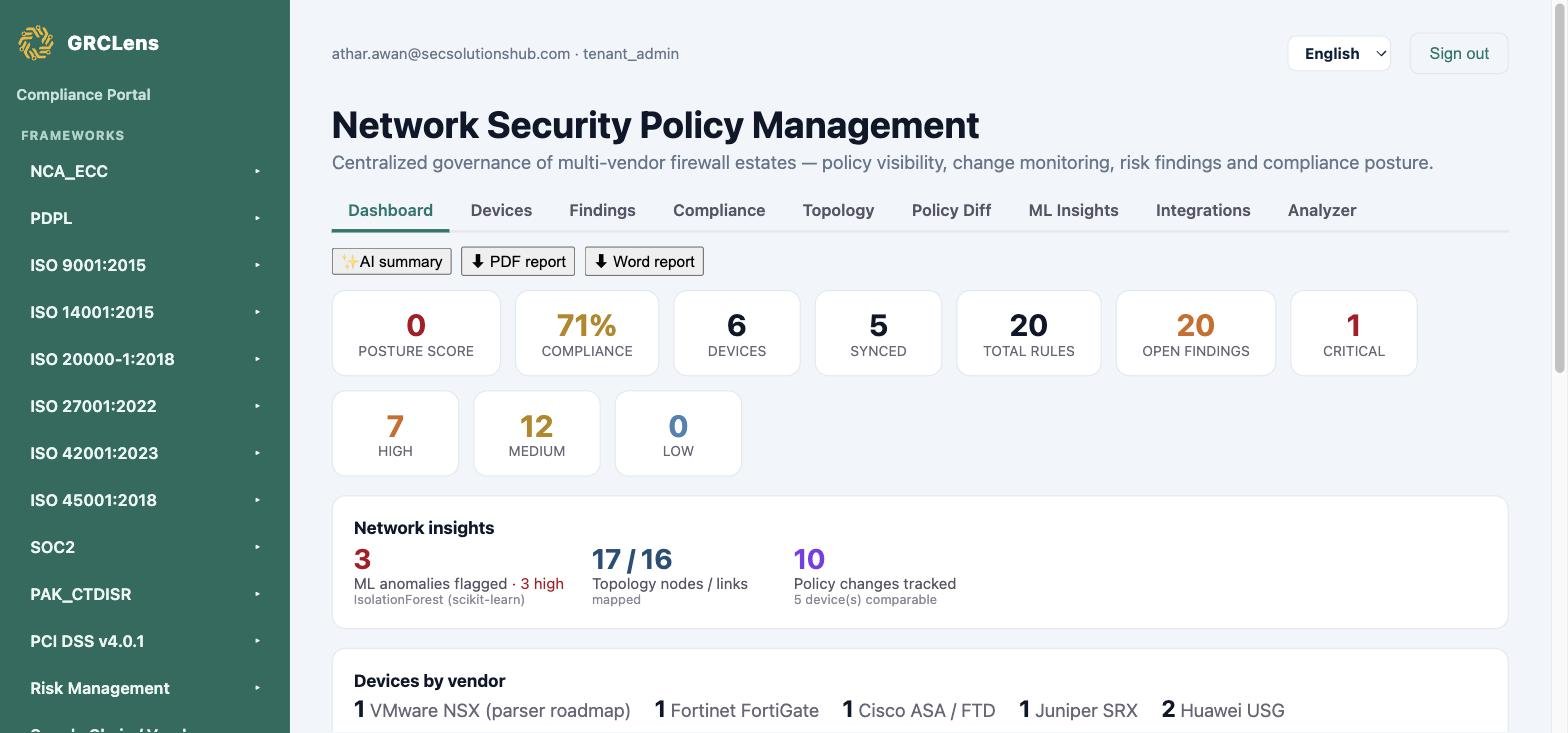
The GRCLens NSPM Dashboard surfaces a posture score, compliance percentage, device sync status, total rules, and open findings (Critical / High / Medium / Low) the moment you log in. Importantly, network Insights highlights ML anomalies flagged, topology coverage, and policy changes tracked. Overall, recent policy changes list device, rule name, change type, and timestamp in real time.
Live Network Topology Mapping
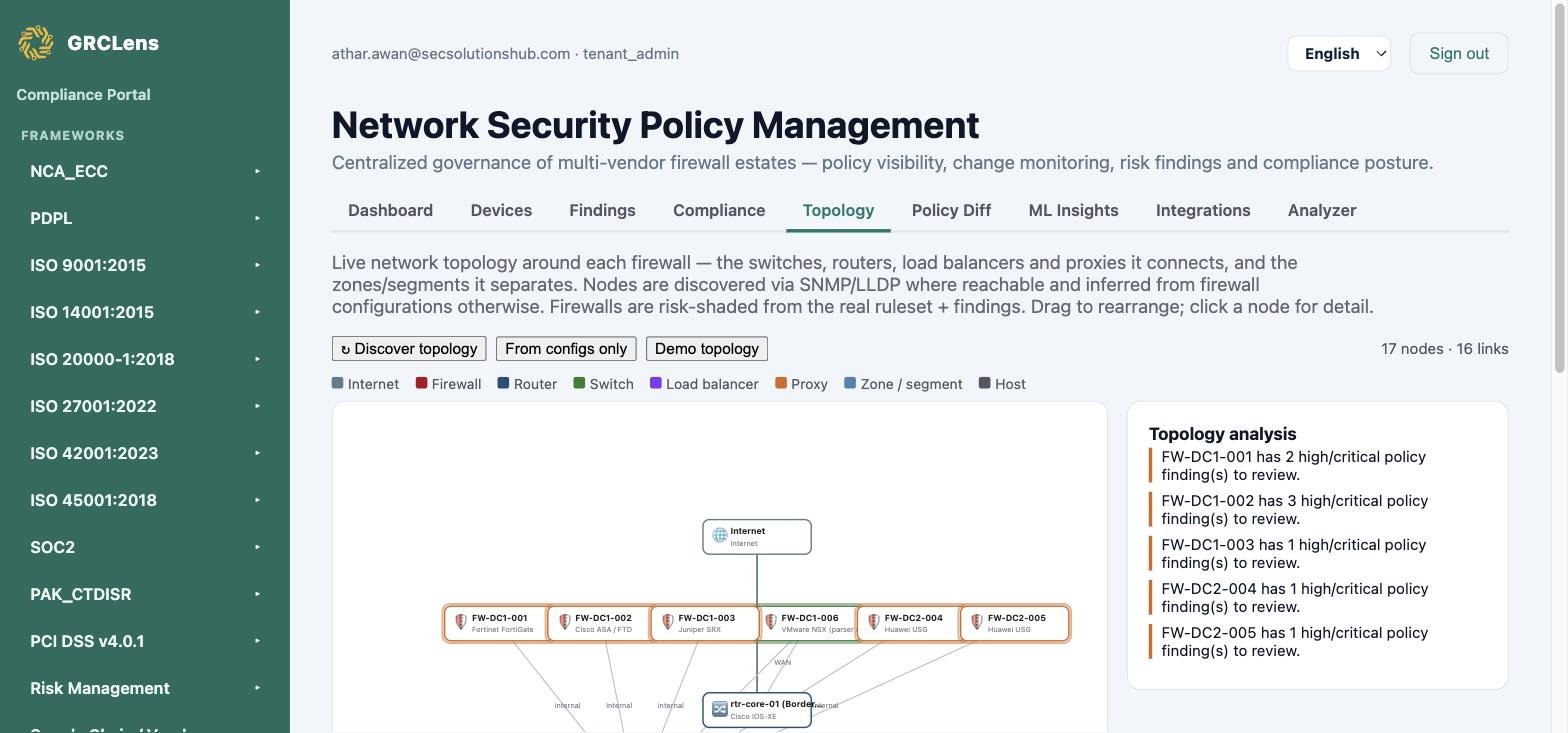
GRCLens discovers and maps every device — Fortinet FortiGate, Cisco ASA/FTD, Juniper SRX, VMware NSX, Huawei USG, routers, switches, load balancers, and proxies — and the zones they separate. Also, nodes are risk-shaded from the real ruleset and findings. In addition, the Topology Analysis panel surfaces high/critical findings per firewall so engineers know exactly where to focus.
ML-Powered Anomaly Detection
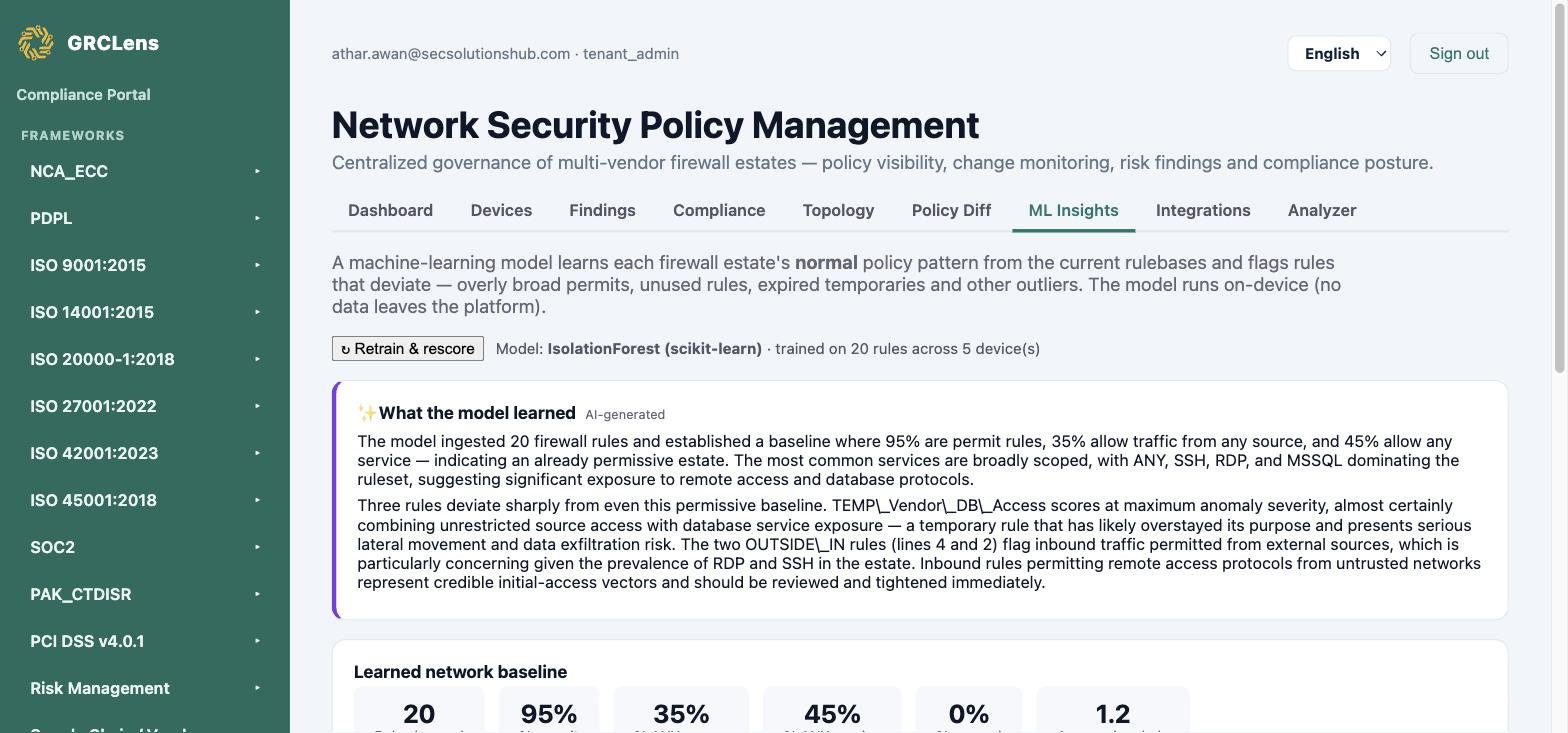
GRCLens runs an IsolationForest model (scikit-learn, on-device — no data leaves your environment) on your firewall ruleset. In addition, it learns each estate’s normal policy pattern and flags statistical outliers: overly broad permits, expired temporaries, and rules that deviate sharply from the baseline. In practice, an AI-generated narrative explains what the model learned and why each flagged rule warrants immediate human review.
Policy Diff — Point-in-Time Change Comparison
GRCLens captures snapshots of every firewall’s rule set at each sync. Notably, the Policy Diff engine compares any two snapshots — showing exactly which rules were added, modified, or removed, with field-level before/after detail and a risk classification (Critical / High / Medium / Low) on every change. Importantly, this gives engineers a precise, auditable change history and gives management evidence that changes are tracked, reviewed, and risk-assessed.
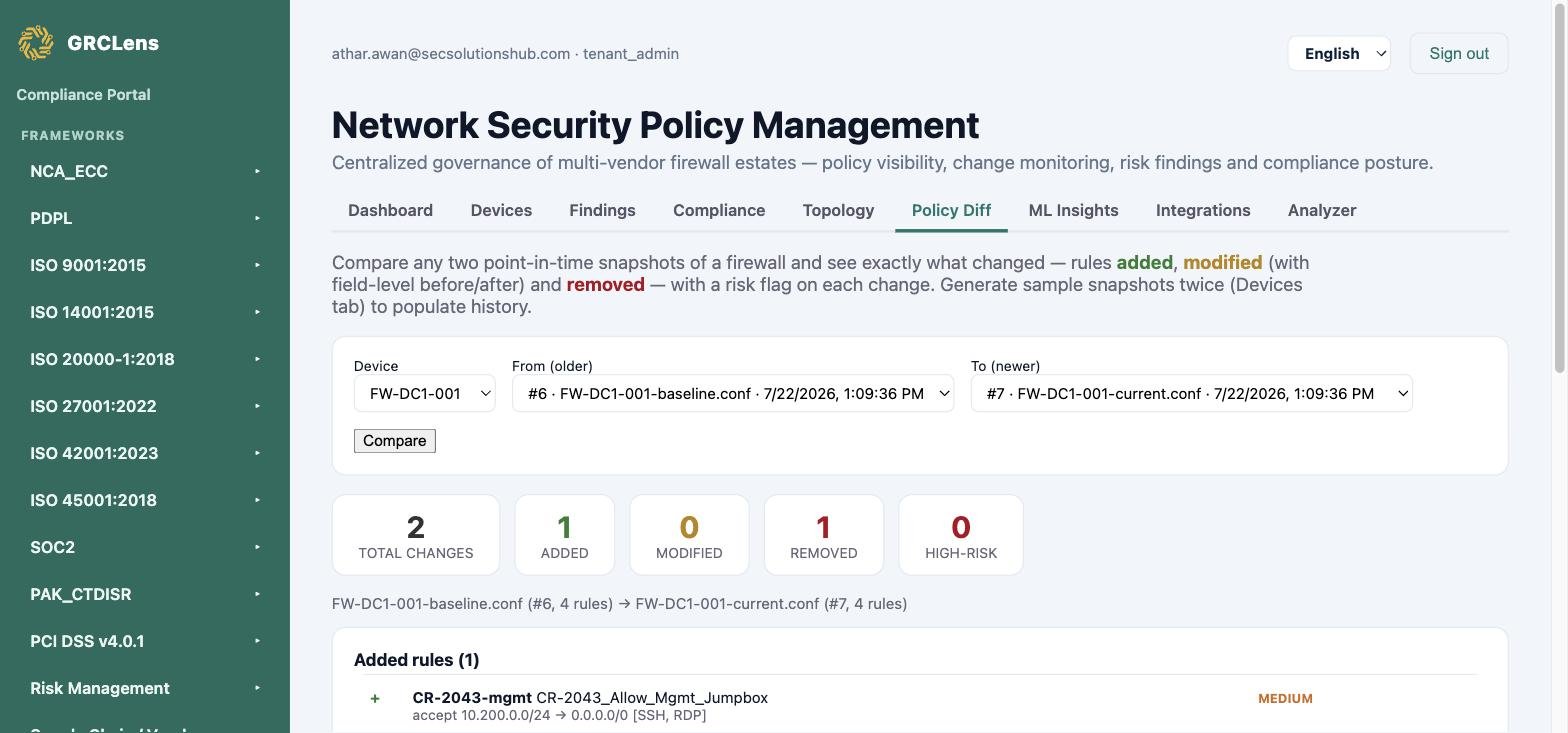
In short, gRCLens NSPM supports: Fortinet FortiGate, Cisco ASA / FTD, Juniper SRX, VMware NSX, and Huawei USG — with additional vendor parsers on the roadmap.
Frequently Asked Questions
What is the difference between NSPM and SIEM or SOAR?
SIEM and SOAR are detection and response technologies — they tell you what is happening on your network in real time. In practice, nSPM is a preventive and governance discipline — it ensures your network security controls are correctly designed, implemented, and maintained so that threats have fewer paths to exploit. Overall, nSPM and SIEM/SOAR are complementary, not alternatives.
We already have a WAF and next-gen firewalls. Do we still need NSPM?
Technology alone does not constitute posture management. Also, nSPM ensures the rules on your NGFWs reflect your security intent, are reviewed regularly, and are changed safely. In addition, the best firewall misconfigured by an uncontrolled rule change is a liability — not an asset.
How long does an NSPM engagement typically take?
A foundational NSPM engagement — discovery, remediation, and process design — typically runs 8–12 weeks for a mid-sized enterprise. In practice, continuous posture management is an ongoing operational capability, not a one-time project.
Which compliance frameworks require NSPM?
ISO 27001, PCI DSS v4.0, ASD Essential Eight, SOC 2, NZISM, and Australia’s SOCI Act (CIRMP) all require demonstrable network security control governance. Notably, nSPM provides the process and evidence to meet these requirements continuously.
Can you help us if we have a hybrid or multi-cloud environment?
Yes. Importantly, our NSPM practice covers on-premises firewalls, cloud-native security groups (AWS, Azure, GCP), SDN environments, and zero-trust architectures. Hybrid and multi-cloud environments often have the most acute posture gaps because rules are rarely translated consistently across environments.
What is GRCLens NSPM and how is it different from other tools?
GRCLens is Security Solutions Consulting’s own purpose-built NSPM platform — not a third-party integration, but a platform developed by SSC. Overall, gRCLens delivers centralised governance of multi-vendor firewall estates with a unified dashboard covering policy visibility, change monitoring, risk findings, and compliance posture. Also, it includes a live topology mapper, ML-powered anomaly detection, a Policy Diff engine for comparing point-in-time snapshots. Also, a Compliance tab mapped directly to your framework obligations. In short, critically, GRCLens is designed for the whole organisation — operations teams, management, and executive leadership — enabling a shared, authoritative view of network security posture from a single platform.
For example, book a free 30-minute NSPM scoping call with the SSC team →
Questions about this article? Contact us at info@secsolutionshub.com
Related reading
- ISO 27001 Implementation Roadmap: 2026 Guide
- How to Build a Practical GRC Framework in 90 Days
- ISO 27001 vs NIST vs CIS Controls
- What is a Cybersecurity Maturity Assessment?
Of course, getting network security policy management right is an ongoing discipline rather than a one-off project. Also, the earlier you build it into your operating rhythm, the less it costs to maintain.
In practice, security Solution Consultants supports organisations across Australia, New Zealand and the Pacific, including Fiji, Samoa and Papua New Guinea.

