

Table of Contents
- The Shift from AI Innovation to AI Accountability
- Why AI Governance in 2026 Is Non-Negotiable
- Hidden Risks in Modern AI Systems
- Why Static Security Policies Fail in AI Environments
- Core Pillars of an AI Governance Framework
- Microsoft Ecosystem for AI Governance
- Dynamic vs Adaptive Protection in the AI Era
- Business Benefits of Strong AI Governance
- Conclusion
- FAQs
The Shift from AI Innovation to AI Accountability
A few years ago, the big question was: How fast can we adopt AI? That question has changed. In 2026, the real question is: Who is responsible when AI goes wrong? AI is now inside core business systems. It helps approve loans, screen job applicants, and manage customer data. The speed of AI adoption has outpaced the rules around it. Many businesses added AI tools quickly, without asking what happens if those tools fail, leak data, or make biased decisions. New Zealand businesses are feeling this pressure. Regulators and clients want proof that AI is being managed, not just used. This is the new reality: accountability has replaced innovation as the top priority.Why AI Governance in 2026 Is Non-Negotiable?
 AI is no longer just a tool that helps people work faster. It is making real business decisions. And when AI makes a wrong decision, the consequences are real too. That is exactly why AI governance in 2026 has become the defining line between businesses that are in control and those that are not. Here is why AI governance in 2026 cannot be optional anymore:
- Regulatory pressure is growing. Governments are passing laws on how AI must be used. The EU AI Act is already in force. Other regions are following.
- Legal and financial risks are real. If your AI causes harm to a customer, employee, or partner, your business can be held responsible.
- Reputational damage is fast and public. A single AI failure can end up in the news before your security team even knows it happened.
- Boards are now responsible. AI risk is now a boardroom issue. Directors can be personally accountable if governance is ignored.
Hidden Risks in Modern AI Systems
Most businesses focus on the visible benefits of AI. The hidden risks are where the real danger sits.Data Exposure Risk
AI tools learn from data. If an employee feeds sensitive client data into an AI system, that data can end up stored, shared, or exposed. This is a direct breach risk, even if it was accidental.Shadow AI Usage
Employees are using AI tools that IT has never approved. This is called shadow AI. It happens because people want to work faster. But those tools have no oversight, no security controls, and no audit trail.Model Risk
AI models can be wrong. They can produce biased outputs. They can hallucinate, meaning they state false information as fact. When this happens in a business decision, the cost can be high.Insider Risk Amplification
AI does not create insider threats, but it makes them faster and bigger. A bad actor with access to AI tools can exfiltrate data at scale in minutes. The speed of harm increases dramatically.Why Static Security Policies Fail in AI Environments?
Traditional security policies are written once and reviewed once a year. That model is broken in an AI environment. Here is the problem: AI behavior is dynamic. It changes based on the data it receives, the user prompting it, and the task at hand. A rule written six months ago cannot predict what an AI tool will do today. Static rules also cannot detect context. A user accessing client records at 9 am looks normal. The same access at 2 am, from a new location, after a resignation notice, that is a completely different risk. A static policy treats both situations the same. AI environments need adaptive governance, rules that change with the risk, in real time.Core Pillars of an AI Governance Framework
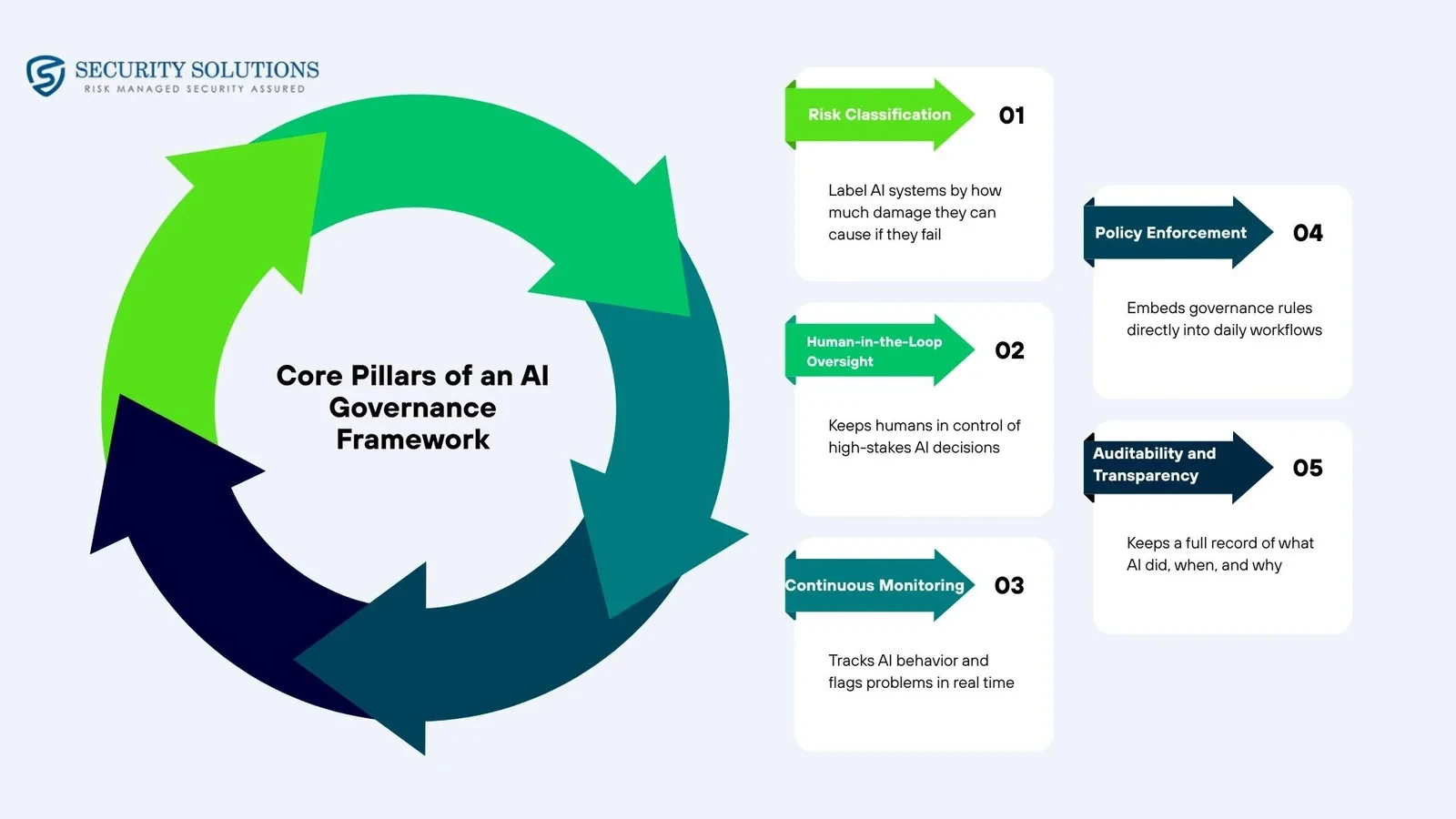 A strong AI governance framework is built on five pillars. Together, they give businesses control over how AI operates inside their systems.
| Pillar | What It Does |
| Risk Classification | Label AI systems by how much damage they can cause if they fail |
| Human-in-the-Loop Oversight | Keeps humans in control of high-stakes AI decisions |
| Continuous Monitoring | Tracks AI behavior and flags problems in real time |
| Policy Enforcement | Embeds governance rules directly into daily workflows |
| Auditability and Transparency | Keeps a full record of what AI did, when, and why |
Risk Classification
Not all AI tools carry the same risk. A chatbot that answers FAQs is very different from an AI that approves insurance claims. Risk classification sorts AI systems into tiers, so your controls match the actual danger.Human-in-the-Loop Oversight
For critical decisions, a human must review what AI recommends before it takes effect. This is not about slowing things down. It is about making sure that AI stays in the role of advisor, not final decision-maker, where it matters most.Continuous Monitoring
You cannot govern what you cannot see. Real-time monitoring watches AI usage across your environment, flagging unusual behavior, unauthorized tools, and data risks as they happen.Policy Enforcement
Governance only works if policies are enforced, not just documented. That means building controls into the tools your teams use every day, not just writing rules in a handbook nobody reads.Auditability and Transparency
If something goes wrong, you need to prove what happened. Auditability means every AI decision leaves a trace. This protects you legally and builds trust with clients and regulators.Microsoft Ecosystem for AI Governance
Microsoft has built a set of tools that work together to govern AI inside enterprise environments. If your business runs on Microsoft 365, these tools are already within reach.- Microsoft Copilot is the AI assistant built into Microsoft 365. It can write emails, summarize documents, and generate content. It is powerful, but it also introduces real risk if not governed properly. Copilot can access data across your tenant, which means poor access controls equal serious exposure.
- Microsoft Purview is the data governance and security compliance platform. It classifies sensitive data, enforces retention policies, and provides visibility across your entire Microsoft environment. Think of it as the foundation of your data compliance strategy.
- Data Loss Prevention (DLP) policies inside Purview stop sensitive information from leaving your environment, whether through email, Teams, or AI tools. This directly addresses the data exposure risk that AI creates.
- Insider Risk Management uses behavior signals to detect employees who may be acting dangerously, whether intentionally or not. It works quietly in the background, building risk scores based on real activity patterns.
- Conditional Access controls who can access what, and under what conditions. It can block access based on device health, location, or risk level. This is the identity layer of your AI governance architecture.
Dynamic vs Adaptive Protection in the AI Era
Static security is a wall. Adaptive security is a living system. A wall stops what it can see coming. It fails against anything new. Adaptive protection watches behavior in real time and adjusts controls automatically. If a user suddenly starts downloading large volumes of data after accessing an AI tool, the system responds, without waiting for a human to notice. Context-aware security asks: Is this normal for this user, at this time, in this place, doing this task? That context changes every hour. Your security must change with it. In an AI-driven environment, adaptive protection is not optional. It is the only model that keeps up.Business Benefits of Strong AI Governance
Governance is not just about reducing risk. Done right, it creates real business value. AI governance in 2026 is the foundation that turns compliance pressure into a competitive advantage.- Faster AI adoption. When teams know AI is governed, they trust it. That trust accelerates adoption without the reckless shortcuts.
- Regulatory readiness. When an auditor or regulator asks how you manage AI risk, you have the answer, documented, tested, and ready.
- Stronger security posture. Governance controls close the gaps that attackers look for. Fewer gaps mean fewer incidents.
- Increased client trust. Clients increasingly ask about data handling and AI use. Governance gives you a clear, confident answer.
- Competitive advantage. Businesses that govern AI well will move faster, safer, and more credibly than those that don’t.
Conclusion
AI governance in 2026 is not a compliance checkbox. It is the foundation that lets businesses use AI safely and grow with confidence. The businesses that will fall behind are not those that ignore AI; they are those that adopt AI without the controls to manage it. Ungoverned AI creates legal exposure, data risk, and reputational damage that can undo years of progress. The businesses that win will be those that treat governance as a strategic advantage, not a burden. Ready to build an AI governance framework for your business? Contact the SecSolutionsHub team today and get a clear plan tailored to your environment.FAQs
1. What is AI governance and why does it matter?
AI governance is the set of rules, controls, and processes that make sure AI systems are used safely, ethically, and within legal requirements. It matters because AI is now making real business decisions, and without governance, those decisions carry serious legal, financial, and reputational risk.2. Why is AI governance a priority, specifically in 2026?
Because AI adoption has accelerated faster than the rules around it. In 2026, regulators in multiple regions are enforcing new AI laws, boards are being held accountable for AI risk, and the consequences of ungoverned AI are no longer theoretical; they are happening to businesses right now.3. How does Microsoft Copilot create governance challenges?
Microsoft Copilot can access data across your entire Microsoft 365 tenant. If access controls are not set correctly, Copilot can surface sensitive information to the wrong people. Governing Copilot means controlling who can use it, what data it can access, and keeping an audit trail of what it does.4. What is Microsoft Purview, and how does it support compliance?
Microsoft Purview is a data governance and compliance platform. It classifies sensitive data, applies retention and protection policies, and gives visibility across your Microsoft environment. It is the core tool for meeting data compliance requirements while using AI and cloud services.5. What is adaptive security, and how is it different from traditional security?
Traditional security uses fixed rules that do not change. Adaptive security monitors behavior in real time and adjusts protections automatically based on context and risk level. In an AI environment where risk changes constantly, adaptive security is the only model that stays effective.Conclusion: How Security Solutions Consulting Can Help
Building a GRC framework that actually works requires the right blend of process design, technology, and specialist expertise. SSC’s GRC advisors have built and matured GRC programmes for organisations across APAC — from ASX-listed enterprises to fast-growing technology companies pursuing their first compliance certification.
GRCLens — GRCLens is SSC’s purpose-built GRC and compliance management platform — providing a unified control library, automated evidence collection, real-time compliance dashboards, and multi-framework support across ISO 27001, SOC 2, Essential Eight, PCI DSS, and more.
Ready to build a practical, continuous GRC programme? Contact our team for a free, no-obligation consultation. We will assess your current position and provide a clear, prioritised roadmap tailored to your organisation.
Explore: GRC & Compliance Advisory | ISO 27001 Advisory | Enterprise Risk Management | GRCLens Platform | Get in Touch

