

Update, October 2026: ASD has published ASD Essentials, the Essential Eight replacement. Read what changes and how to move your Essential Eight work across.
Essential 8 compliance: Table of Contents
- What Is the Essential Eight?
- Why Essential 8 Compliance Matters in 2026
- The 8 Controls Explained in Plain English
- Essential Eight Maturity Levels: 0 to 3 Explained
- Which Maturity Level Does Your Business Need?
- How to Implement Essential Eight: Step by Step
- What Most Businesses Miss: AI Threats and the Essential Eight Gap
- Essential Eight and Other Frameworks
- How GRC Makes Essential Eight Easier
- Essential Eight Compliance Checklist
- Why Work With an Essential Eight Advisory Partner in Australia?
- Conclusion
- FAQs
What Is the Essential Eight?
The ACSC Essential Eight framework is a set of eight cybersecurity controls. The Australian Cyber Security Centre developed it. Importantly, it is built from real analysis of thousands of cyber incidents across Australian organisations. The framework targets three core objectives:| Objective | Controls | Purpose |
| Prevent Attacks | Application Control, Patch Apps, Office Macros, App Hardening | Stop malicious code from running |
| Limit Impact | Restrict Admin Privileges, Patch OS, MFA | Contain damage if attackers get in |
| Recover Data | Regular Backups | Restore operations after an attack |
Why Essential 8 Compliance Matters in 2026
A cybercrime is reported every six minutes in Australia. Of course, the average cost for a small business is $46,000 per incident. For medium businesses, it reaches $97,000. These are direct costs only. Specifically, they do not include lost clients, damaged reputation, or weeks of lost productivity. Four pressures are pushing Essential 8 compliance in Australia up every business priority list right now.- Cyber Insurance Insurers now ask detailed questions about your Essential Eight alignment at every policy renewal. Businesses with strong compliance get better premiums. For example, businesses without it face higher costs or refusal of cover entirely.
- Government Contracts Over 90% of Australian government tenders now reference Essential Eight compliance. Also, if you supply to government, healthcare, education, or defence clients, this is a commercial requirement, not a suggestion.
- Client Expectations: Your clients are checking your security posture before signing contracts. In addition, the Essential Eight gives you a recognised framework to demonstrate their data is protected.
- Board and Director Liability Directors have a personal duty of care regarding cybersecurity. Cybersecurity compliance is now a board-level governance issue. In practice, privacy Act fines can reach up to $50 million for serious or repeated breaches.
Essential 8 compliance in practice: The 8 Controls Explained in Plain English
Here is what each control does and why it matters. No technical jargon. Plain English only.- Application Control: Only approved software can run on your systems. If malware lands on a device it cannot execute. Think of it as a strict guest list for your IT environment. Uninvited software does not get in.
- Patch Applications: Every app has vulnerabilities. Vendors release fixes regularly. Apply them within 48 hours for critical vulnerabilities. Unpatched apps are one of the most common entry points attackers use.
- Configure Microsoft Office Macros: Macros are small programs inside Word and Excel files. Attackers use them to deliver malware. Block macros from the internet. Only allow digitally signed macros from trusted sources.
- User Application Hardening: Disable unnecessary features in browsers and PDF viewers. Block Flash, Java, and web ads. Every feature is a potential attack surface. Fewer features mean fewer ways attackers can get in.
- Restrict Administrative Privileges: Admin accounts have the keys to everything. Limit who has them strictly. Use separate accounts for admin tasks only. This limits the blast radius if an attacker gets inside your network.
- Patch Operating Systems: Same logic as patching apps, applied to Windows, macOS, and servers. Unsupported operating systems must be replaced immediately. WannaCry ransomware exploited a patched Windows vulnerability. Organisations that applied the patch were completely unaffected.
- Multi-Factor Authentication: Require two forms of identity verification before accessing systems. A password plus an authenticator app or hardware key. Using Conditional Access policies makes this automatic across your whole environment. MFA blocks over 99.9% of automated credential attacks.
- Regular Backups: Back up critical data, software, and configuration settings regularly. Store backups separately from your production environment. Test them every 90 days minimum. Good Data Loss Prevention (DLP) controls work alongside backups to stop data from leaving your business without authorisation.
Essential Eight Maturity Levels: 0 to 3 Explained
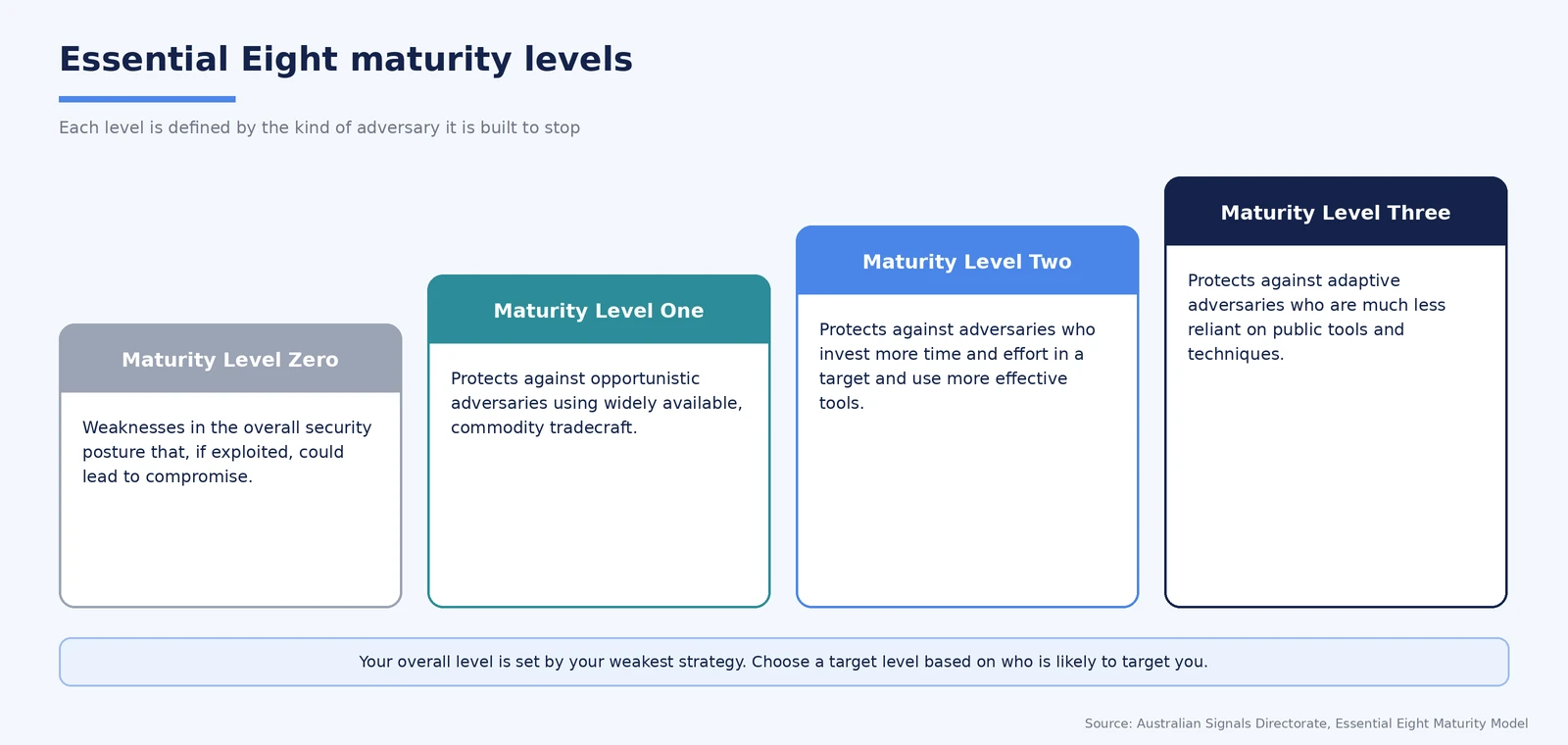 The Essential Eight maturity levels run from 0 to 3. Notably, each level builds on the one below it.
Level | Name | What It Means |
| Level 0 | Minimal | No real controls, highly vulnerable |
| Level 1 | Partial | Basic protections, defend against opportunistic attacks |
| Level 2 | Managed | Strong controls enforced, now the expected AU baseline |
| Level 3 | Optimised | Advanced defence, critical infrastructure and defence |
Essential 8 compliance: Which Maturity Level Does Your Business Need?
Your target level depends on your industry, risk profile, and who you do business with in Australia.- Small businesses (under 20 staff): Minimum Level 1
- SMEs (20–200 staff) handling client data: Level 2
- Australian government suppliers: Mandatory Level 2
- Healthcare, finance, or critical infrastructure organisations: Level 2 to Level 3
- Defence supply chain businesses: Level 3
How to Implement Essential Eight: Step by Step
The Essential Eight implementation guide is not a single project. It is a continuous cycle. Overall, here is the practical approach used by Australian businesses.- Baseline Assessment: Map your current maturity across all eight controls. Test actual configurations, not just written policies. In short, you cannot improve what you have not properly measured.
- Gap Analysis: The assessment reveals weaknesses. Not all gaps carry equal risk. Focus first on high-value systems like domain controllers, email platforms, and remote access pathways.
- Build Your Roadmap: Create a 90-day plan for quick wins. Build a 12-month plan for structural changes. Of course, define clear owners and success criteria for every single control.
- Implement in Phases: Start with patching and MFA first. These deliver maximum protection with minimum disruption. Application control and privilege restriction take longer but deliver the biggest impact overall.
- Test and Validate: Every control must be tested after implementation. Can a standard user run unapproved software? Are backups actually restorable when needed? Specifically, assume nothing works until you have proven it does.
- Monitor and Maintain: New software needs whitelisting. New patches need to be deployed. For example, new staff need correct access levels from day one. The Essential Eight maturity assessment cycle never truly ends. Maintain it continuously, not periodically.
What Most Businesses Miss: AI Threats and the Essential Eight Gap
This is the section most Essential Eight guides never cover. It is critically important in 2026. The Essential Eight was built before generative AI became a mainstream business tool. Also, it has no controls for AI threats whatsoever. And this gap is growing dangerously fast across Australia. 51% of Australian organisations encountered AI-powered threats last year. 76% of those saw threat volumes double in that same period. In addition, here is what the Essential Eight does NOT protect you from:Shadow AI Data Leakage
Staff copy contracts, client records, and financial data into public AI tools every day. In practice, this data gets exposed or used to train AI models. The Essential Eight has no control over this risk at all. This is a growing Insider Risk that most Australian businesses are completely unprepared for right now.AI-Powered Phishing
AI now generates perfect phishing emails. No grammar errors. No spelling mistakes. No red flags at all. Notably, traditional email filters built around old Essential Eight assumptions simply cannot catch them anymore.Deepfake Social Engineering
AI convincingly clones executive voices and video. Importantly, staff transfer funds, believing it is a legitimate instruction from leadership. No Essential Eight control addresses this threat directly. What your business must add BEYOND Essential Eight in 2026:- AI Governance policies define which AI tools are approved and block the rest completely
- Insider Risk monitoring, detect unusual internal behaviour before serious damage occurs
- A GRC framework that wraps around Essential Eight and fills these dangerous gaps
Essential Eight and Other Frameworks
The ASD Essential Eight does not exist in isolation. Overall, it connects directly to other frameworks Australian businesses regularly encounter.| Framework | How It Connects to Essential Eight |
| ISO 27001 | E8 builds a strong foundation for certification |
| Privacy Act 2024 | E8 demonstrates reasonable security steps taken |
| NIST CSF | E8 aligns with Identify, Protect, and Recover functions |
| SMB1001 | E8 controls included across Bronze Silver Gold tiers |
| SOCI Act | E8 supports critical infrastructure compliance obligations |
| GRC Framework | E8 sits within broader governance, risk and compliance management |
How GRC Makes Essential Eight Easier
Most Australian businesses treat Essential Eight compliance as a standalone IT project. This is a costly mistake. In short, businesses that do it right embed Essential Eight inside a broader GRC framework from the start. Here is why this matters so much. Controls drift over time naturally. New staff join. New software gets installed. Exceptions accumulate quietly. Without governance, nobody watches the full picture. Of course, without a GRC approach, your Essential Eight maturity degrades silently between assessments without anyone noticing. Essential Eight GRC consulting Australia brings a completely different approach:- Controls are tracked and monitored continuously, not just at audit time
- Evidence collected automatically, always audit-ready
- Risk mapped across the whole business, not just IT systems
- Board reporting is built in, and leadership stays informed always
Essential Eight Compliance Checklist
Use this checklist today to measure where your business stands right now. Prevent Attacks- Application control is enabled across all systems
- Applications patched within 48 hours of critical updates
- Microsoft Office macros blocked from the internet
- Browser and PDF viewer hardening are configured properly
- Administrative privileges restricted and regularly reviewed
- Operating systems patched within required timeframes
- Phishing-resistant MFA is enabled for all users
- Privileged accounts cannot browse internet or read email
- Daily backups of critical data are running consistently
- Backups stored separately from the production environment
- Backup restoration tested within the last 90 days
- Backups protected from deletion or modification
- 11-12: Strong Essential Eight posture maintain and improve
- 7-10: Gaps exist, prioritise remediation now
- 0-6: Urgent, significant risk exposure, act immediately
Why Work With an Essential Eight Advisory Partner in Australia?
Most Australian businesses that fail Essential 8 compliance do so for one reason. They treat it as a checkbox exercise. Controls exist on paper but are never tested in practice. Also, assessors and attackers both test real configurations, not documentation. A specialist partner brings what most internal teams simply do not have. Independent assessment without bias. In addition, practical gap analysis based on real tested configurations. A phased roadmap that fits your actual business operations. Ongoing monitoring so maturity does not drift. In practice, audit-ready evidence when insurers or procurement panels come calling unexpectedly. Security Solutions Hub is a trusted Essential Eight advisory services provider in Australia. We conduct independent maturity assessments across all eight controls. Notably, we build practical uplift roadmaps tailored to your industry and risk profile. Our GRCLens platform keeps your Essential 8 compliance on track continuously, not just at audit time.Conclusion
Essential 8 compliance is no longer optional for Australian businesses in 2026. Importantly, it is the expected baseline for every organisation storing client data, supplying to the government, or maintaining cyber insurance coverage. Cybercrime costs Australian small businesses $46,000 per incident on average. Overall, privacy Act fines reach $50 million for serious breaches. The cost of compliance is always less than the cost of a breach. Start with a baseline assessment. Know exactly where you stand. Build a practical roadmap. In short, do not stop at the Essential Eight alone. make sure your framework also covers AI threats, insider risks, and governance gaps that the framework alone cannot address.Ready to Assess Your Essential Eight Compliance?
Book a free Essential Eight maturity assessment with the Security Solutions Hub team today. We will map your current maturity level, identify your priority gaps, and give you a clear, practical roadmap, built specifically for your Australian business. Book Your Free Assessment NowFAQs
Q1. Of course, is Essential Eight compliance mandatory for Australian businesses? It is mandatory for government entities. For private businesses, it is technically voluntary. However, insurers, government procurement teams, and enterprise clients now treat it as the minimum baseline. If you supply to the government or handle sensitive data, it is effectively required. Q2. For example, what is the difference between Maturity Level 1 and Level 2? Level 1 means basic protections exist but are not always consistent. Also, level 2 means controls are enforced across ALL systems and regularly reviewed. Level 2 is now the government-recommended baseline for all Australian industries in 2026. Q3. In addition, how long does it take to achieve Essential 8 compliance? Small businesses can reach Level 1 in one to three months. In practice, level 2 typically takes six to twelve months for most Australian SMEs. Working with a specialist partner reduces this timeline significantly. Q4. Does Essential Eight cover AI cyber threats? No, this is a critical gap. Notably, the Essential Eight has no controls for shadow AI data leakage, AI-powered phishing, or deepfake attacks. Businesses must add AI Governance policies on top of Essential Eight to stay protected in 2026. Q5. Importantly, how much does Essential Eight compliance cost for an Australian SME? A baseline assessment starts from a few thousand dollars. Overall, full Level 2 implementation ranges from $15,000 to $80,000, depending on business size and gaps found. Strong compliance reduces cyber insurance premiums by 20 to 40%, offsetting a large part of the investment.Conclusion: How Security Solutions Consulting Can Help
Moving from Maturity Level 0 to Level 2 or Level 3 requires more than policy documentation — it requires verified technical controls, governance processes, and evidence of operational effectiveness. In short, sSC’s Essential Eight specialists have guided ASX-listed companies, government agencies, and critical infrastructure operators through every maturity level, delivering sustainable uplift rather than point-in-time compliance. Below, we break down Essential 8 compliance in practical terms.
GRCLens — GRCLens provides continuous Essential Eight maturity visibility — tracking your level across all eight controls, flagging gaps as they emerge, and generating the evidence your auditors and leadership need automatically.
Ready to uplift your Essential Eight maturity? Contact our team for a free, no-obligation consultation. Of course, we will assess your current position and provide a clear, prioritised roadmap tailored to your organisation.
Explore: Essential Eight Advisory | Maturity Assessment | ISO 27001 Advisory | GRCLens Platform | Get in Touch
Further reading: Australian Cyber Security Centre.
Security Solution Consultants supports organisations across Australia, New Zealand and the Pacific, including Fiji, Samoa and Papua New Guinea.
Need help putting this into practice? See our Essential Eight compliance and assessment services — including independent gap assessment, Maturity Level 2 uplift, and planning for ASD’s new Essentials series.

