Cyber Security and Data Protection Consultants in Nairobi

Yellow circular logo with intertwined abstract shapes next to "Business Continuity Management (BCM).
EASMLens external attack surface management platform logo
NSPM network security policy management logo
PhishLens phishing simulation and awareness logo

Security Solution Consultants (SSC) are cyber security consultants for Nairobi organisations that need to meet Kenya’s Data Protection Act, the Central Bank of Kenya’s cybersecurity guidelines, ISO 27001 and PCI DSS. We work with banks, payment service providers, insurers, SACCOs, healthcare providers and regional headquarters in Westlands, Upper Hill and Kilimani, combining practical GRC consulting with GRCLens, our own GRC platform.

Kenyan professionals planning a compliance programme on a glass board in a Nairobi office, representing cyber security and data protection consultants in Nairobi
Nairobi is East Africa’s financial and technology hub, and a prime target.

Why Nairobi organisations are acting now

  • Kenya’s national CERT, KE-CIRT/CC, detected 11.12 billion cyber threat events between July 2025 and June 2026, up 29% on the year before.
  • The Office of the Data Protection Commissioner (ODPC) had registered more than 15,000 data controllers and processors by January 2026, and had issued penalty notices and compensation orders against banks, lenders, schools and hospitality businesses.
  • Serianu’s 2025 Africa Cyber Security Report estimated Kenya’s cybercrime losses at KES 29.9 billion.
  • The October 2025 breach of a health payments platform exposed records of millions of Kenyans and went undetected for about ten days.

The obligations we help you meet

ObligationWho it applies toWhat it asks for
Data Protection Act 2019 and the 2021 RegulationsData controllers and processors, with registration required above the thresholds or in listed sectorsRegistration with the ODPC, lawful processing, data protection impact assessments, security by design, and breach notice to the ODPC within 72 hours
CBK cybersecurity guidance for banks (2017) and payment service providers (2019)Banks and licensed payment service providersBoard accountability, a CISO, controls and testing, and incident notification to the CBK within 24 hours
Computer Misuse and Cybercrimes (CII and Cybercrime Management) Regulations 2024Owners of designated critical information infrastructureA CISO, a risk assessment within 12 months, reporting of changes, and hosting the infrastructure in Kenya
IRA Guidance Note on Cybersecurity (2025)Insurers and reinsurersA board approved strategy and notice of material incidents within 24 hours
Digital Health Act 2023 and the 2025 Health Information RegulationsHealth facilities and digital health solution providersHealth data custodianship, security operations, breach notification and certification of digital health solutions
PCI DSS v4.0.1Merchants, acquirers, issuers and payment providers handling card dataTwelve requirement areas, with the future-dated requirements mandatory since 31 March 2025

Payments, mobile money and PCI DSS

A customer and an agent holding smartphones at a mobile money kiosk on a Nairobi street, representing payment security and PCI DSS in Kenya
Mobile money now carries half of Kenya’s documented fraud cases.

Kenya’s payments ecosystem is built on mobile money, cards and fast-growing digital lenders, and fraud follows the money. The National Computer and Cybercrimes Coordination Committee reported in 2026 that mobile money accounted for half of documented fraud cases, and the CBK recorded 353 bank cyber fraud cases in 2024, more than double the year before. The CBK launched a Banking Sector Security Operations Centre in September 2025 and expects banks and payment providers to report incidents to it.

We assess banks and payment service providers against the CBK guidelines, prepare PCI DSS scoping and Self-Assessment Questionnaires or QSA assessments, and design the testing and incident reporting that supervisors ask about. See our PCI DSS compliance advisory.

Data Protection Act compliance

The ODPC expects registration certificates to be renewed before they expire, and in August 2026 it gave lapsed entities 14 days to renew. Beyond registration, the Act requires a lawful basis for every purpose, data protection impact assessments for high risk processing, data protection by design, processor contracts, and breach notice to the ODPC within 72 hours (48 hours from a processor to its controller). Fines reach KES 5 million or 1% of annual turnover, whichever is lower, and the ODPC also orders compensation to complainants.

We register you, build the records and policies, run DPIAs, and set up the monitoring that keeps you compliant. In July 2026 the ODPC also consulted on AI guidance that would require DPIAs for eight common AI uses, including credit scoring and recommendation engines.

Health data under the Digital Health Act

A clinician entering patient information on a tablet in a modern Kenyan clinic, representing health data protection under the Data Protection Act and the Digital Health Act
Health data is sensitive personal data, with its own rules.

Health data may only be processed by a health care provider or a person under a duty of professional secrecy, and the Digital Health Act 2023 adds custodianship, security and certification rules for digital health solutions. With more than 32 million Kenyans registered with the Social Health Authority, hospitals, clinics, insurers and health technology providers are handling more sensitive data than ever.

We help health organisations secure patient systems and suppliers, prepare for ODPC and Digital Health Agency scrutiny, and rehearse breach response.

ISO 27001 certification and audits in Kenya

Two auditors reviewing an evidence binder and a laptop with an IT manager in a Nairobi meeting room, representing ISO 27001 certification and data protection audits in Kenya
Certification turns good intentions into evidence an auditor can test.

Kenyan banks and insurers have pursued ISO 27001 certification for years, and public tenders, from the Kenya Revenue Authority to pension funds, increasingly ask for it. KENAS has accredited the Kenya Bureau of Standards to certify against ISO/IEC 27001:2022, alongside international certification bodies. A well scoped ISMS also gives you the evidence for Data Protection Act security duties and CBK expectations.

We design the scope, run the risk assessment, prepare evidence and support you through certification. Learn more about our ISO 27001 implementation and advisory.

AI governance, ISO 45001 and resilience

  • AI governance: Kenya launched its National AI Strategy 2025 to 2030 in March 2025, and KEBS has published a code of practice for AI applications. Our ISO 42001 consulting builds an AI management system around them.
  • Occupational safety: the Occupational Safety and Health Act 2007 requires annual safety and health audits by an approved adviser, and organisations such as KenGen and the Kenya Ports Authority have certified to ISO 45001. See our ISO 45001 consulting.
  • Resilience: business continuity management and incident response for organisations that cannot afford downtime.

GRCLens: one platform to run your GRC function

Consulting gets you compliant. GRCLens, the governance, risk and compliance platform we built and use on every engagement, keeps you compliant. It orchestrates your regulatory and legislative compliance in one place, so your risk, compliance and audit teams work from the same controls, evidence and numbers.
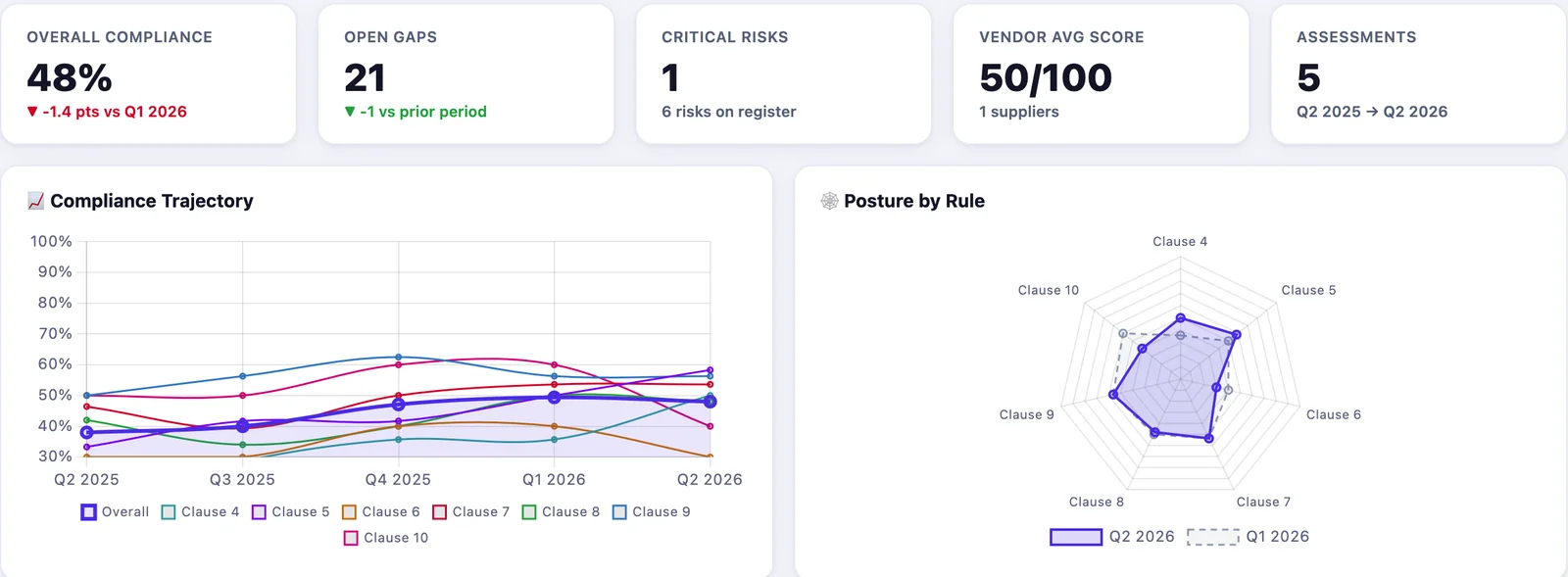
GRCLens board dashboard showing overall compliance, open gaps, critical risks, a compliance trajectory across five assessments and posture by clause
The GRCLens board view: compliance trend, open gaps, critical risks and posture by requirement.
  • Local law and international standards side by side. the Data Protection Act 2019 sit in GRCLens next to ISO/IEC 27001, ISO/IEC 42001, ISO 45001, ISO 22000, PCI DSS, SOC 2 and IEC 62443, each with its own requirement catalogue.
  • Map once, comply many times. A shared control model reuses one piece of evidence against every obligation it satisfies, instead of collecting it again for each regulator.
  • Assurance built in. Every local framework carries an Assurance domain for audits, reviews and control monitoring, so you can show controls work, not just that they are documented.
  • Risks, indicators and suppliers. A risk register with key risk indicators traced to appetite, follow-up actions with owners and dates, and third-party assessments with vendor scores.
  • Board ready. Dashboards show the compliance trajectory, open gaps and critical risks, with an AI executive briefing and PDF and Word reports for the board and the regulator.
  • Hosted where your data must stay. GRCLens can run on premises in your own data centre or in a cloud region you choose. For designated critical information infrastructure, that means you can keep GRC data in Kenya.

See GRCLens for Kenya, or request a GRCLens demo.

How we work with organisations in Nairobi

  • Remote first, on site when it matters. Our consultants run gap assessments, policy work, risk workshops and evidence reviews remotely, and we work with a local partner firm for on-site walkthroughs, interviews, audits and plant visits in Nairobi.
  • One programme, many obligations. We map your controls once and reuse the evidence across local law, ISO standards, PCI DSS and your customers’ security questionnaires, instead of running a separate project for each.
  • Consulting and platform together. We configure GRCLens with your obligations, controls and evidence during the engagement, so your own team runs the programme after we hand over, with our consultants on call for audits and regulatory change.
  • Fixed scope, fixed quote. After a short scoping call you receive a written scope, timeline and price.

We also support organisations in Johannesburg, Cape Town, Lusaka and Harare.

Frequently asked questions

Registration is mandatory for data controllers and processors above the thresholds in the 2021 Registration Regulations, and for organisations in the listed sectors regardless of size. Certificates must be renewed before they expire.

GRCLens is the governance, risk and compliance platform we built and use on every engagement. It holds your obligations, controls, evidence, risks and board reporting in one place. Many clients keep using it after the project to run their compliance programme, but our consulting does not depend on it.

A data controller must notify the ODPC within 72 hours of becoming aware of a breach that creates a real risk of harm, and a processor must notify its controller within 48 hours. Banks and payment providers also have 24 hour notice duties to the Central Bank of Kenya.

Yes. ISO 27001 gives you the risk assessment, security controls and evidence that the Act's security and data protection by design duties expect, although it does not cover lawful basis, data subject rights or registration on its own.

We deliver most work remotely and use a local partner firm for on-site interviews, walkthroughs and audits in Nairobi.

PCI DSS is a contractual requirement from the card schemes and acquirers for anyone that stores, processes or transmits card data. Kenyan payment providers also have CBK cybersecurity obligations, and we align both.

Talk to us about cyber security in Nairobi

Tell us where you are today and what you need to achieve. We will come back with a clear scope, timeline and fixed quote.