

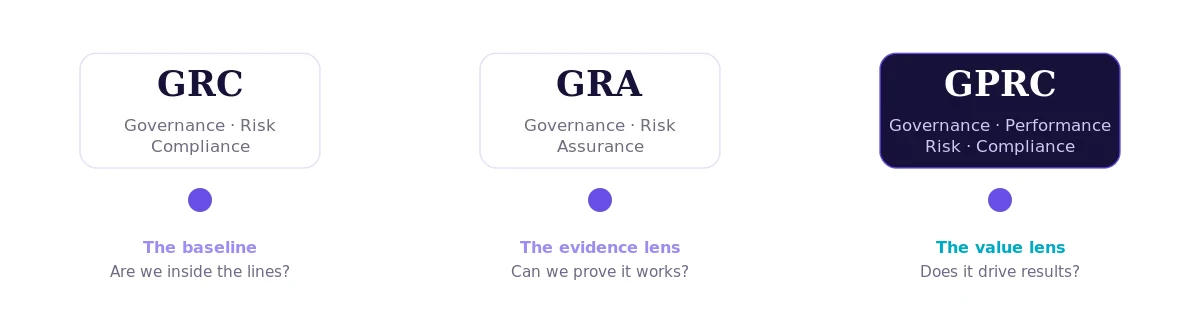
If you work in governance, risk and compliance, you have watched the acronyms multiply. First came GRC — Governance, Risk and Compliance. Then GRA appeared, swapping the “C” for Assurance. And now, at conferences and on vendor stands, a fourth letter has arrived: GPRC, where the P stands for Performance. GRC, GRA and GPRC are three of the latest, and this article shows how they connect.
It is tempting to call this buzzword inflation. It is not. In fact, each variant signals where the profession is heading. First we ticked boxes. Then we proved controls work. Now we tie all of it back to business results. So none of them replaces the others. Instead, each one widens the lens. To see why, let us lay them on a single timeline.
GRC: the baseline everyone shares
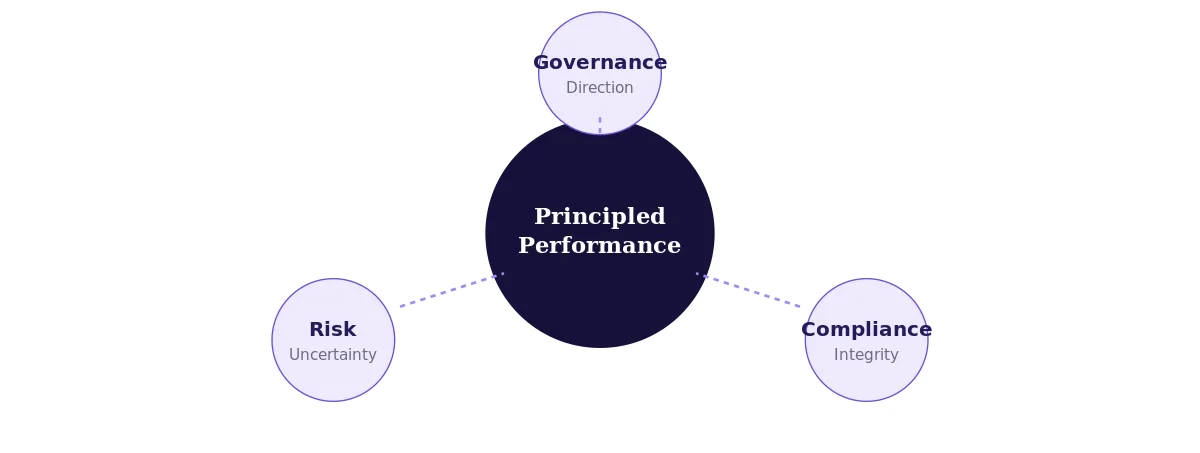
OCEG coined GRC to describe the capabilities that help an organisation achieve objectives, manage uncertainty and act with integrity. It calls this goal Principled Performance. The three pillars are simple. Governance sets direction and accountability. Risk finds and treats what could go wrong. And Compliance keeps you aligned with laws, regulations and policy.
Crucially, GRC never meant three separate teams filing three separate reports. Instead, its whole point is integration. Governance, risk and compliance should work from one view of the truth. In practice, though, many teams fall short. The risk register sits in one spreadsheet. The evidence sits in another. And the board sees a third version, stitched together the night before a meeting.
So this gap drives everything that follows. Each later variant reacts to it. Each argues that three letters, while correct, quietly undersold something important.
GRA: swapping “Compliance” for “Assurance”
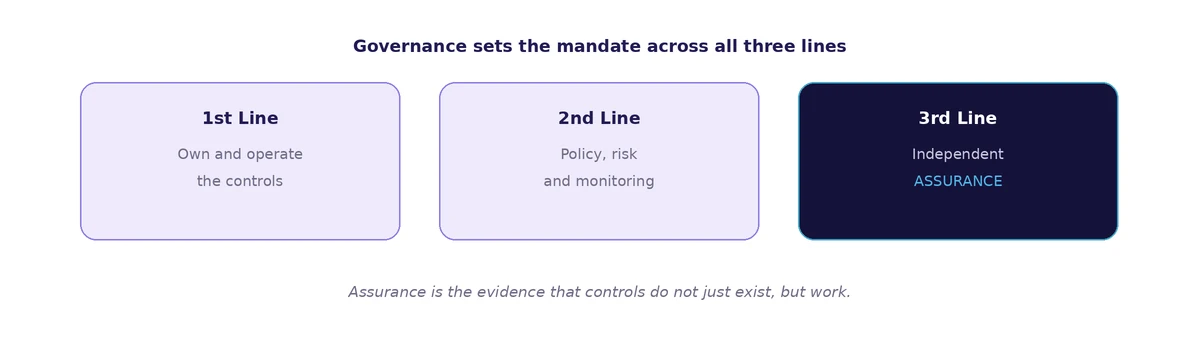
GRA — Governance, Risk and Assurance — is less a rival than a maturity step. Its point is simple but powerful. Compliance tells you a control exists. Assurance tells you it actually works. Over time, boards and regulators grew tired of clean audit reports that arrived just before messy incidents. So the focus shifted. “We have the policy” no longer counted. “Here is independent proof the policy operates” became the new bar.
This idea maps neatly onto the Three Lines model. First, the first line owns and runs controls day to day. Second, the second line sets policy and monitors risk. Third, the third line gives independent assurance. GRA puts that third function front and centre. In other words, it means proving, with evidence, that your claims hold up. So a “green” dashboard is not enough. You also need a timestamped record that shows why it is green, and who checked it.
For Australian entities, this shift matters in practice. For example, APRA CPS 234 and the SOCI Act now expect testable evidence of control effectiveness. A signed attestation no longer settles the question. Therefore GRA speaks the language regulators now use: assurance as a daily outcome, not a yearly event.
GPRC: putting Performance on the board
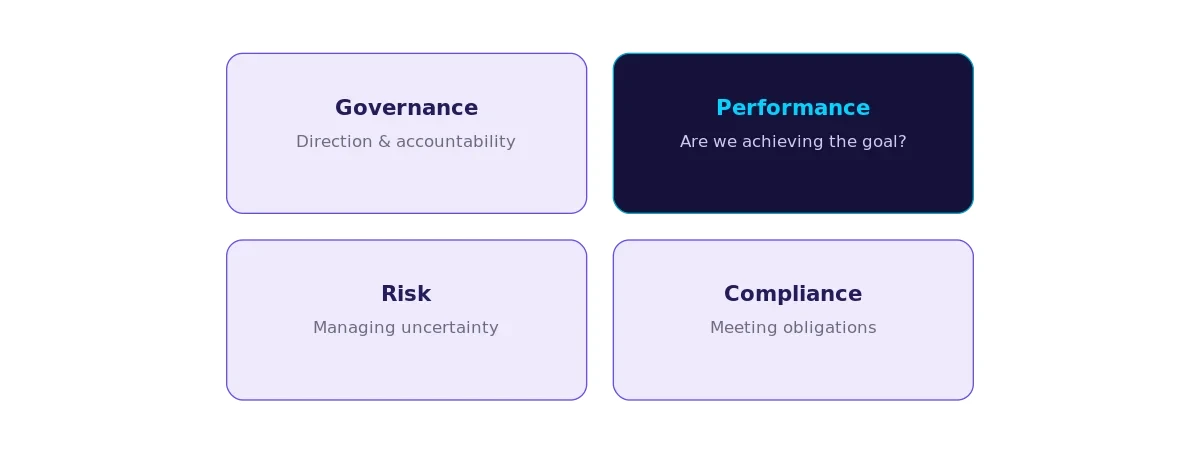
GPRC adds Performance as an explicit pillar: Governance, Performance, Risk and Compliance, managed together. The reasoning is blunt. Too often, risk and compliance act only as brakes. They say “no” and “slow down.” So GPRC names performance directly. As a result, you judge governance by whether it helps you reach your goals, not just by whether it avoids penalties.
Interestingly, this is less a new idea than a rediscovered one. OCEG already tied GRC to Principled Performance. GPRC simply refuses to leave that intent unspoken. Instead, it promotes performance to a measured pillar, with its own metrics, owners and reporting.
The effect shows up in the questions leaders ask. Before, they asked “are we compliant, and what did it cost?” Now, a GPRC-minded board asks a sharper question. It asks whether the control environment helps the business move faster, win trust and enter markets — and whether you can prove it. So compliance becomes an enabler, not a tax.
How GRC, GRA and GPRC actually relate
In short, these are not three rival frameworks. Instead, they are one discipline seen through widening lenses. GRC is the foundation. GRA turns up the assurance dial and demands evidence. GPRC turns up the performance dial and demands results. So mature teams do not pick one. They hold all three intentions at once.
Side by side, the differences are really about emphasis. Each model simply pushes a different question to the front of the room.
| Model | Stands for | Central question |
|---|---|---|
| GRC | Governance, Risk, Compliance | Are we inside the lines? |
| GRA | Governance, Risk, Assurance | Can we prove our controls work? |
| GPRC | Governance, Performance, Risk, Compliance | Does it drive business results? |
What GRC, GRA and GPRC mean for practitioners
So the lesson is not to chase the newest acronym. Instead, make sure your operating model can answer all three questions from one place. In practice, that means governance, risk, compliance, assurance and performance share the same evidence. As a result, a control’s status, the proof it works, and its link to a goal become one record, not three.
First, ask where your current model breaks. Can you show an auditor today, with a timestamp, that a control runs? Or can you only show that a policy exists? Next, ask what happens when a risk changes. Does the compliance and performance picture move with it? Or does someone reconcile it by hand? If the honest answers involve manual effort and stale files, the acronym matters far less than the gaps.
As a result, this is exactly the gap that technology should close. When evidence stays continuous, rather than assembled at audit time, the picture stays current. And when risk and performance read from the same live data, the labels stop mattering. GRC, GRA and GPRC then merge into one defensible view of how well you are governed.
Where GRCLens fits
GRCLens is built for exactly this convergence. It brings multi-framework control management (governance and compliance), a live risk register (risk), timestamped evidence with a full audit trail (assurance), and executive reporting that ties back to objectives (performance) — from one source of truth.
Related reading: How to Build a Practical GRC Framework in 90 Days · ISO 27001 Implementation Roadmap: 2026 Guide
New letters will keep arriving. Someone, somewhere, is already drafting the slide that adds a fifth. But the direction is clear. First we proved we followed the rules. Then we proved our controls work. Now we prove they help the business win. So whatever comes next, one thing holds true. A team that can evidence all three from one place will always stay ahead of the acronym.

